Contrary to the popular « upside-down house » test, the line between buildings and contents insurance hinges on legal tests of permanence and damage on removal.
- Items intended to be permanent and that cannot be removed without damage, like glued-down flooring, are typically considered ‘buildings’.
- Your lease agreement’s ‘demised premises’ clause is the ultimate authority for what a leaseholder is responsible for insuring.
Recommendation: Proactively review your policy definitions and lease documents before a loss occurs; do not rely on general assumptions to avoid a rejected claim.
For any leaseholder, a rejected insurance claim can be a source of immense frustration and financial stress. You diligently pay your premiums, believing you are covered, only to be told the damaged item—perhaps your new laminate floor—falls under a different policy. The common advice is to imagine turning your property upside down; whatever falls out is ‘contents’, and what remains is ‘buildings’. This is a dangerously oversimplified rule of thumb that frequently leads to disputes, especially in the nuanced context of modern homes and flats in the UK.
The reality is far more complex, involving principles of fixtures, fittings, and specific legal tests that insurers and ombudsmen use to adjudicate these grey areas. The distinction is not a matter of opinion but of established criteria. But what if the true key to avoiding disputes was not in guessing which category an item falls into, but in understanding the *precise questions an adjudicator would ask*? This perspective shifts the focus from ambiguity to a clear, methodical assessment of your own property and policies.
This guide will deconstruct the most common points of contention, from flooring and garden structures to fitted kitchens and the unique responsibilities of leaseholders. By examining the issue through the lens of an insurance dispute adjudicator, we will provide the definitive tests and principles you need to determine where cover truly lies, empowering you to secure the right protection and challenge unfair decisions with confidence.
To navigate these complexities, we have broken down the core issues into a series of detailed examinations. This structure will guide you through the specific tests and precedents that determine coverage for every part of your home, from the floorboards to the garden wall.
Summary: Distinguishing Buildings and Contents Coverage for UK Homes
- Why Carpets Are ‘Contents’ but Laminate Is Often ‘Buildings’ in the UK?
- Is the Shed ‘Buildings’ and the Mower ‘Contents’? How to Cover Garden Assets
- The Garden Wall: Is It Covered Under Buildings Insurance if It Collapses?
- Renters Installing Shelves: Are They Covered by Landlord’s Buildings or Tenant’s Contents?
- Why Separating Buildings and Contents Policies Can Sometimes Save £100?
- Pipes and Cables: Who Pays for Underground Services That Collapse?
- Who Insures the Floorboards? The Grey Area Between Leasehold and Freehold
- Fitted Kitchens and Bathrooms: Are They Buildings or Contents?
Why Carpets Are ‘Contents’ but Laminate Is Often ‘Buildings’ in the UK?
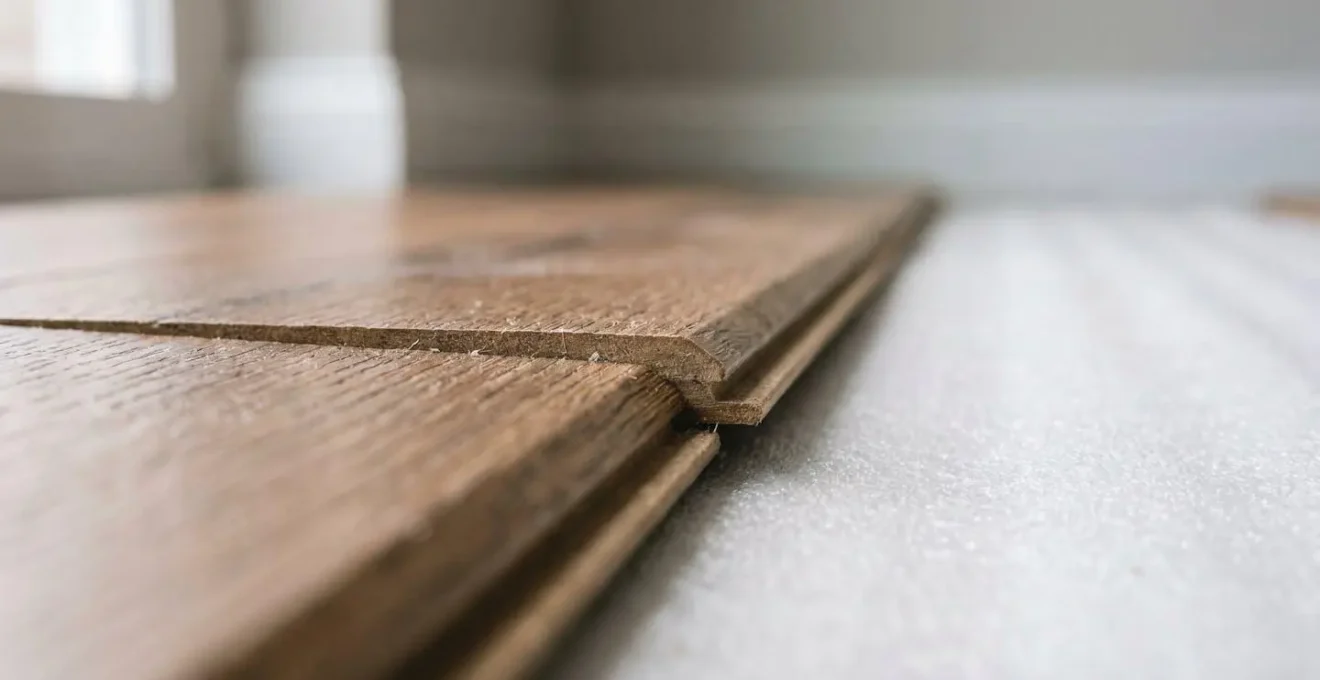
The distinction between different types of flooring is a classic insurance grey area and the perfect illustration of why the « upside-down house » test fails. A carpet, held by gripper rods, can be lifted and moved with relative ease, clearly marking it as ‘contents’. Laminate flooring, however, introduces a crucial legal and practical test: the principle of ‘fixtures and fittings’. The method of installation becomes the determinative factor.
From an adjudication perspective, the key question is whether the item has been fixed to the building in a way that makes it a permanent feature. The Financial Ombudsman Service (FOS), a key authority in resolving these disputes in the UK, has provided clear guidance on this. As they state in their public guidance on home insurance, their position is firm.
We take the view that most laminate wooden flooring (where the individual planks are glued together and fixed under a skirting board or beading) is a ‘fixture and fitting’, not ‘contents’. Unlike a carpet, it is difficult to remove intact and has, essentially, become part of the building.
– Financial Ombudsman Service, Financial Ombudsman Service – Home and Buildings Insurance Guidance
This leads to the ‘damage on removal’ test. The industry standard is that if a floor covering is glued or nailed down and could not be removed without being damaged or damaging the subfloor, it is considered part of the buildings. However, this is not absolute. The FOS has also acknowledged that modern « click-together » laminate flooring, which is designed to be easily taken up and reused, may be classified as contents, as it is no more fixed than a fitted carpet. The specific nature of the product and its installation is therefore paramount.
Is the Shed ‘Buildings’ and the Mower ‘Contents’? How to Cover Garden Assets
Assets located in the garden present another common area of confusion. The principle remains the same: a distinction must be made between the permanent structure and the movable items within it. Generally, outbuildings such as sheds, greenhouses, and summerhouses are considered part of the ‘buildings’ provided they are permanent structures with solid foundations. A flimsy, self-assembled shed resting on bare earth might be debatable, but a shed on a permanent concrete base is almost certainly covered by the buildings policy.
The items stored inside the shed, however, are ‘contents’. This includes your lawnmower, garden tools, furniture, and bicycles. It is crucial to check the limits on your contents policy for items stored in outbuildings, as cover is not always unlimited. Research from Defaqto shows that while most policies offer some cover, the amount can vary significantly. You must ensure your high-value items, like a premium lawnmower or expensive power tools, do not exceed the ‘single-item limit’ or the total outbuilding limit specified in your policy.
To determine if your outbuilding qualifies as a permanent structure, consider the following points:
- Does it have a permanent concrete or slab foundation?
- Is it wired for electricity with a fixed installation?
- Is it plumbed for water or connected to drainage?
- Can it be easily dismantled and moved, or is it a permanent fixture?
A « yes » to these questions strongly indicates it falls under your buildings insurance. Conversely, the lawnmower, even if heavy, remains contents. Ensuring it is properly secured, as shown above, can also be a condition of your insurance.
The Garden Wall: Is It Covered Under Buildings Insurance if It Collapses?
A garden wall, fence, gate, or hedge that forms the boundary of your property is unequivocally part of the ‘buildings’. However, coverage for its collapse is one of the most disputed areas of home insurance. The reason for the dispute is that standard buildings policies do not cover damage from all causes. They cover specific, named ‘perils’ such as storm, flood, fire, or impact from a vehicle. They explicitly exclude damage from wear and tear, lack of maintenance, or inherent defects.
This means if your garden wall collapses, the burden of proof is on you to demonstrate it was caused by a covered peril. An insurer will often argue the collapse was due to gradual deterioration, frost damage over time, or poor construction, none of which are covered. The definition of a ‘storm’ itself is a point of legal contention, as established in a key precedent case.
Storm means storm and to me it denotes some sort of violent wind, usually accompanied by rain, hail or snow. Storm does not mean persistent bad weather, nor does it mean heavy rain or persistent rain by itself.
– Judge in Oddy v Phoenix Insurance Co Ltd (1966)
A famous Financial Ombudsman case (73/08) involved a 140-year-old wall where the insurer rejected the claim, citing age. The FOS, however, ruled in the policyholder’s favour, showing that age alone is not a valid reason for rejection if the insurer cannot prove it was the cause over a potential storm. Given that rebuilding costs can be substantial, with the Chartered Institute of Loss Adjusters noting costs can exceed £1,300 per m², understanding this distinction is vital. You must be prepared to provide evidence, such as meteorological reports, to support a claim related to storm damage.
Renters Installing Shelves: Are They Covered by Landlord’s Buildings or Tenant’s Contents?
When a tenant makes alterations to a rental property, it creates a clear line of demarcation for insurance purposes. Any improvement made by a tenant at their own expense and for their own benefit is classified as a ‘tenant’s improvement’. These are not covered by the landlord’s buildings insurance policy; they are the tenant’s responsibility and must be insured under their own contents insurance policy.
This principle applies to a wide range of common alterations, including installing new shelves, putting in new laminate flooring, or even repainting. The landlord’s buildings insurance is designed to cover only the original structure of the property and the fixtures that the landlord provided at the start of the tenancy. It will not respond to damage to items the tenant has added.
Furthermore, if the tenant’s improvement causes damage to the landlord’s property—for example, a poorly installed shelf falls and damages the wall—the situation becomes a liability issue. The damage to the wall would not be covered by the landlord’s buildings insurance as ‘accidental damage’. Instead, the tenant would be held liable for the repair costs. This liability is typically covered under the ‘tenant’s liability’ section of a comprehensive contents insurance policy, which is designed precisely for such events. It’s a critical component of any renter’s insurance, protecting them from claims for damage to the landlord’s building.
Why Separating Buildings and Contents Policies Can Sometimes Save £100?
For many homeowners, a combined buildings and contents policy offers simplicity and convenience. However, separating the two policies can sometimes lead to significant cost savings. This is particularly true for owners of non-standard properties, such as homes with thatched roofs or listed buildings, which require specialist (and often expensive) buildings insurance. By taking out a specialist policy for the building and a separate, standard policy for the contents from a mainstream provider, the total premium can be much lower.
While the average combined policy costs around £191 per year, analysis has shown that buying separately could be cheaper. However, this cost-saving strategy comes with a significant risk: the ‘clash of insurers’ in the event of a claim involving a grey-area item. If a flood damages your fitted kitchen, the buildings insurer might argue it’s contents, and the contents insurer might argue it’s buildings, leaving you caught in the middle with no payout.
With a combined policy from a single insurer, any such ambiguity is resolved internally. There is no dispute between companies. The following table breaks down the key considerations when deciding between a combined or separated approach, with data suggesting the potential for savings but also highlighting the risks.
| Aspect | Combined Policy | Separated Policies |
|---|---|---|
| Average Annual Cost | £191 – £199 | Potentially cheaper (e.g. buildings £173, contents £57 separately) |
| Claims Process | Single point of contact, one insurer handles entire claim | Risk of ‘clash of insurers’ if grey-area items involved (e.g., fitted kitchens) |
| Grey-Area Items | Insurer decides internally; no inter-company dispute | High risk: both insurers may deny responsibility, leaving policyholder without payout |
| Coverage Gaps | Lower risk; single policy terms apply | Higher risk of uninsured gaps between policies (e.g., mould from flood claimed late) |
| Best For | Standard construction homes, convenience seekers, those prioritizing claim simplicity | Non-standard construction (thatched roof) requiring specialist buildings insurer with standard contents elsewhere |
Pipes and Cables: Who Pays for Underground Services That Collapse?
Damage to underground services like water pipes, drains, and electricity cables that serve your home is a major concern, as repairs can be extraordinarily expensive. These services are considered part of the ‘buildings’, but coverage is not straightforward. You are typically responsible for the section of pipe or cable that runs from the boundary of your property to your home. The section beyond your boundary is the utility provider’s responsibility. The huge sums paid out by insurers for weather-related events, which according to the Association of British Insurers (ABI) can be vast, often include claims for subsidence or ground heave that can cause such pipes to fracture or collapse.
The biggest pitfall in this area is not the cost of the pipe repair itself, but the cost of finding the problem. Standard buildings policies often cover the ‘repair’ but exclude the cost of excavation to ‘trace and access’ the leak. This can leave you with a bill for thousands of pounds for digging up your garden or driveway, even if the pipe repair is covered. Therefore, ensuring your policy includes ‘Trace and Access’ cover is absolutely essential. This add-on specifically covers the cost of locating the source of a leak. Without it, you are significantly exposed.
Action Plan: Verifying Cover for Underground Pipes
- Verify Policy Details: Check your policy documents to confirm ‘Trace and Access’ cover is explicitly included, not just cover for the repair itself.
- Identify Boundaries: Locate the demarcation point on your property deeds or with your utility provider to understand the exact length of pipe you are responsible for.
- Assess Shared Supply: Determine if your pipes are on a shared supply line with neighbours, as this creates joint responsibility and requires collaboration in the event of a claim.
- Document Damage Cause: Understand that cover applies to accidental damage (e.g., tree root damage, collapse). Blockages from misuse or general wear and tear are typically excluded.
- Report Immediately: Contact your insurer as soon as you suspect an underground leak. Delays can lead to further water damage and complicate the claims process.
Following this process methodically is the only way to ensure you are protected from the significant costs associated with failures in underground services.
Who Insures the Floorboards? The Grey Area Between Leasehold and Freehold
For a leaseholder in a flat, the question of who insures structural elements like floorboards is of paramount importance. Unlike a freehold homeowner who owns the entire building and land, a leaseholder owns a right to occupy a space for a set period. The physical extent of that ownership is defined by a critical clause in the lease agreement: the ‘demised premises’. This clause is the ultimate arbiter in any dispute.
Typically, the freeholder (or landlord) is responsible for insuring the entire building structure, including walls, ceilings, and the structural floor joists, via a ‘master’ or ‘block’ buildings policy. The leaseholder then pays a share of this premium through their service charge. However, the lease might specify that the leaseholder’s ownership extends to non-structural elements within that space. A landmark case from a major housing association clarified this point, noting that the lease explicitly defined the demised premises as including ‘the upper surface of the floorboards’. In such a case, the floorboards themselves (but not the joists beneath) are the leaseholder’s property to maintain and insure.
This makes it absolutely essential for a leaseholder not to rely on general assumptions. You must obtain and scrutinise your lease. Under UK leasehold law, leaseholders have a legal right to request and inspect a copy of the freeholder’s master buildings insurance policy to see what it covers. If your laminate flooring is damaged by a leak from above (a building peril), but your lease states you own the floorboards and the surface on top, a claim on the master policy could be complex. You may need to demonstrate the damage originated from a part of the building you don’t own, or rely on your own contents policy if it covers fixtures and fittings you are responsible for.
To Be Remembered
- The ‘permanence and damage on removal’ test is the true measure used by insurers, not the oversimplified ‘upside-down house’ rule.
- The cause of damage is critical; policies cover specific ‘perils’ and exclude wear and tear, a frequent point of dispute for things like garden walls.
- For leaseholders, the lease agreement’s ‘demised premises’ clause overrides all general rules and is the final authority on responsibility.
Fitted Kitchens and Bathrooms: Are They Buildings or Contents?
Fitted kitchens and bathrooms are prime examples of items that blur the line between buildings and contents. These high-value installations are composed of multiple elements, some of which are clearly ‘buildings’ and others that could be considered ‘contents’. The fundamental principle of integration and permanence is the key to untangling this. Sanitary ware (baths, toilets, basins), kitchen units, and worktops that are plumbed in and fixed to the walls are considered permanent fixtures and therefore part of the building.
Appliances, however, are more complex. The deciding factor is how they are installed. A freestanding appliance, like a Smeg fridge that is simply plugged in, is ‘contents’. An integrated appliance, one that is built into the kitchen units and hidden behind a matching cabinet door, becomes part of the fitted kitchen and is therefore considered ‘buildings’. The key tests are:
- The Gravity Test: If you could turn the house upside down and it would fall out, it is likely contents.
- The Integration Test: Has it been physically integrated into the building’s fabric, such as being plumbed in or having a cabinet door fixed to it? If so, it’s likely buildings.
- The Damage on Removal Test: Would removing the item cause damage to the property? A built-in oven is buildings; a countertop microwave is contents.
It is also vital to distinguish between standard cover and accidental damage. While a fire or flood that destroys your kitchen is a standard peril covered by buildings insurance, dropping a heavy pan and cracking your expensive granite worktop is not. This falls under ‘accidental damage’, which is an optional add-on to most policies. Without this extension, you would not be covered for many common mishaps.
| Type of Damage | Standard Buildings Insurance | Accidental Damage Add-On |
|---|---|---|
| Fire damage to kitchen units | ✓ Covered | ✓ Covered |
| Flood damage to fitted cabinets | ✓ Covered | ✓ Covered |
| Dropping a pan and cracking induction hob | ✗ Not covered | ✓ Covered |
| Chipping granite worktop accidentally | ✗ Not covered | ✓ Covered |
| Subsidence affecting kitchen structure | ✓ Covered | ✓ Covered |
| Wear and tear / aging appliances | ✗ Not covered | ✗ Not covered |
Frequently Asked Questions on Buildings vs Contents Insurance
Are tenant-installed shelves covered by the landlord’s buildings insurance?
No. Modifications made by a tenant at their own expense, such as shelves or new flooring, are classified as ‘tenant’s improvements’ and are covered by the tenant’s contents policy, not the landlord’s buildings policy. The landlord’s buildings insurance only covers the original structure and fixtures provided by the landlord.
What happens if a tenant-installed shelf damages both the wall and the tenant’s property?
This creates a liability chain where different parts of the tenant’s insurance respond. Damage to the wall (landlord’s property) would be covered under the tenant’s liability section of their contents policy. Damage to the tenant’s TV or belongings would be covered under their contents section. Any injury to a guest would fall under the tenant’s personal liability cover.
Do tenants need written permission from landlords before installing fixtures?
Yes. Installing fixtures without the landlord’s written permission can breach the tenancy agreement, potentially making the tenant liable for the full cost of repairs regardless of insurance. Most tenancy agreements require express consent for any alterations to the property structure.