An insurer rejecting a claim based on « wear and tear » is not a final verdict; it’s an opening argument that a specialist report is designed to dismantle.
- Forensic reports use objective data (CCTV, thermal imaging, DNA) to prove a specific, sudden event, which is the definition of insurable « accidental damage ».
- These reports translate physical evidence into the precise language of policy liability, leaving no room for ambiguity or subjective dismissal.
Recommendation: Engage a specialist not just to find the damage, but to build a robust, evidence-based case that forces your insurer to honour their policy.
You’ve submitted your claim, waited weeks, and finally, the letter arrives. It’s not good news. The insurer has rejected your claim, or offered a fraction of what is needed, using vague, frustrating terms like « wear and tear, » « lack of maintenance, » or « pre-existing issue. » For many homeowners facing complex property damage, this feels like an insurmountable brick wall. You know the damage is real and was caused by a specific event, but you lack the language and evidence to fight back effectively against a large institution.
This is the critical moment where a specialist report transforms your position. It’s a common misconception that these reports merely « find the leak » or « check the cracks. » Their true function is far more powerful. A properly executed report from a specialist surveyor or engineer acts as a forensic rebuttal. It systematically dismantles the insurer’s objections by providing objective, scientific proof of causation, timing, and severity. It translates the physical reality of your damaged property into the precise, irrefutable language of policy liability.
Instead of a « he said, she said » debate, you present a dossier of evidence that speaks the only language an insurer is contractually obligated to understand: verifiable fact. This article will break down exactly how different types of specialist reports provide this critical leverage, turning your legitimate claim from a request into a demand backed by expert validation.
This guide explores the specific forensic tools at a specialist’s disposal, demonstrating how each one is deployed to counter common insurer objections and build an undeniable case for your claim.
Summary: Structural Reports and Winning Your Insurance Claim
- The Drain Camera: Proving the Blockage Is Accidental Damage, Not Wear?
- Thermal Cameras: Finding Hidden Damp Without Destructive Testing?
- The Lightning Strike Report: Proving Surge Damage to Appliances?
- The DNA Root Test: Proving Which Tree Caused the Subsidence?
- The Roof Report: Certifying That the Roof Was in Good Condition Before the Storm?
- Finding the Leak: Why You Need at Least £5,000 in ‘Trace and Access’ Cover?
- Oak Trees and Clay Soil: The Risk Event That Costs £20,000 to Fix
- Flood, Subsidence, or Theft: Which Risk Event Is Most Likely in Your Postcode?
The Drain Camera: Proving the Blockage Is Accidental Damage, Not Wear?
One of the most common reasons for claim denial, especially for water damage originating from drains, is the « wear and tear » exclusion. The insurer argues that the pipe simply failed due to age. A CCTV drain survey is the definitive counter to this argument. It’s not just about finding a blockage; it’s about identifying the specific cause and nature of the failure. The high-resolution camera travels through the pipework, documenting its condition in real-time.
This visual evidence is crucial. A report can pinpoint a single, fresh crack from ground movement, a clear root intrusion at a specific joint, or a collapsed section from a sudden event. These are all examples of accidental damage—a specific, insurable event—not gradual deterioration. The report provides a timestamped, visual record that makes it very difficult for an adjuster to maintain a vague « wear and tear » stance. The evidence is simply too precise, and it is standard practice that recorded footage is frequently used for insurance claims when proving the origin of damage.
As drainage survey specialists highlight, the output is more than just a video; it’s a structured, forensic document. According to the experts at Clark Drainage:
The video footage and defect log show the insurer the cause of the problem in clear, dated terms. A cracked pipe at a specific location, a root mass blocking a junction, a collapsed section under the driveway.
– Clark Drainage, What Does A CCTV Drain Survey Do
This level of detail transforms the conversation from a subjective opinion on the pipe’s age to an objective discussion about a documented, specific point of failure.
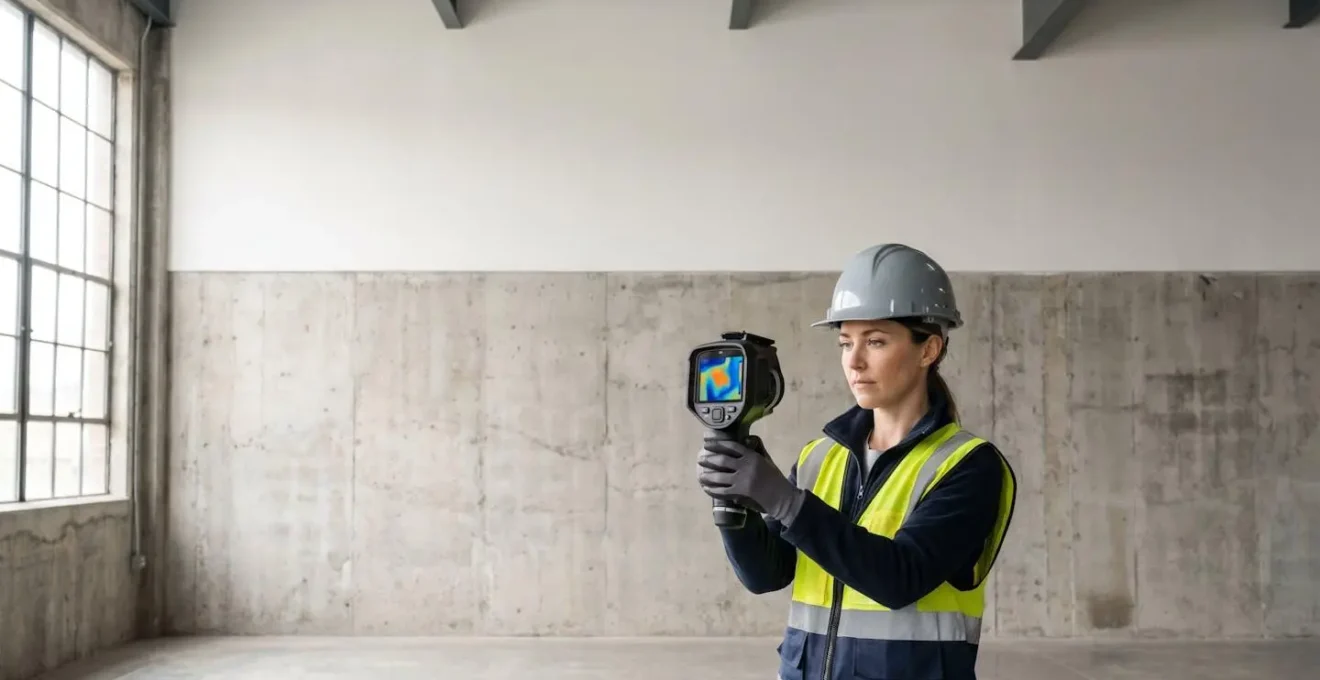
Thermal Cameras: Finding Hidden Damp Without Destructive Testing?
An insurer is often reluctant to approve a claim for « escape of water » without knowing the exact source. They will not pay for speculative or destructive searches, leaving you in a difficult position: you can’t prove the leak without making holes in your walls, but you can’t get approval to make holes without proving the leak. This is where thermal imaging provides an elegant and powerful solution. By detecting minute temperature differences on a surface, it allows a specialist to « see » hidden moisture without any physical damage.
Modern thermal cameras are incredibly sensitive, revealing hidden issues through temperature variations as small as 0.1°C. A cold patch on a wall or floor, invisible to the naked eye, can definitively map the extent of water saturation from a hidden pipe. This creates a clear, visual « leak path » that pinpoints the source. The report, filled with thermographic images, provides undeniable proof of an active leak and its location, justifying the subsequent access required for repair.
Case Study: £3,000 in Potential Damage Avoided with Thermal Imaging
A homeowner in Enfield (N21) noticed damp patches but could not locate the source, and their insurer requested a formal report before approving any work. A leak detection team used acoustic sensors and thermal imaging to trace the leak to a pipe hidden within a bathroom wall. They provided a full, insurer-approved report with photographic and thermographic evidence. The client’s claim was approved within five days, covering the cost of the detection and subsequent repair, and preventing over £3,000 in further water damage that would have occurred had the leak remained undiscovered.
This non-invasive method not only saves your property from unnecessary damage but also provides the insurer with the exact evidence they require to approve « trace and access » costs and proceed with the claim.
The Lightning Strike Report: Proving Surge Damage to Appliances?
When lightning strikes near a property, it can send a massive power surge through the electrical system, destroying sensitive electronics from the inside out. To the naked eye, a television or computer may look perfectly fine, making it difficult to prove the cause of failure. An insurer may argue the appliances were old or failed for other reasons. A specialist report on surge damage provides the forensic evidence to counter this.
An engineer will examine the building’s wiring, outlets, and the internal circuit boards of the damaged appliances. They look for specific tell-tale signs of a high-voltage surge: arcing marks, fried components, and melted circuits that are distinct from normal electronic failure. The report documents this microscopic evidence, creating a clear causal link between the lightning event and the appliance failure. This is a significant issue, with one report showing that 55,537 lightning claims were filed in the U.S. in 2024, demonstrating the frequency of such events.
The report will methodically list each damaged item, detail the specific surge-related damage found within it, and conclude that the pattern of failure is consistent with a single, high-energy event like a lightning-induced surge. This level of detail moves the claim away from a simple list of broken items to a forensic analysis of an electrical event, making it far more difficult for an insurer to reject.
The DNA Root Test: Proving Which Tree Caused the Subsidence?
Subsidence claims are complex and expensive, and a key point of contention is often identifying the exact cause. If a large tree is implicated, the question becomes: which tree? Is it your tree, your neighbour’s tree, or a tree owned by the local council? The liability, and therefore who pays, hinges on this question. Guesswork is not an option, and insurers will not proceed without definitive proof. For decades, this relied on microscopic analysis, which could be subjective.
Today, a far more precise tool exists: DNA analysis of tree roots. When foundations are exposed to investigate subsidence, a surveyor can take samples of the fine roots found in the damaged area. These samples are sent to a specialist lab, where their DNA is extracted and compared against reference samples taken from all suspect trees in the vicinity. The result is an unambiguous match, identifying the species and the exact source tree with scientific certainty.
This technology is routinely applied when seeking to prove tree root damage to buildings and infrastructure for litigation or insurance claims.
– Treenet Research, Tree Root Identification using DNA Fingerprinting
This report removes all doubt and argument. It provides irrefutable evidence of causation, allowing the insurer to confidently pursue the liable party for the costs (a process known as subrogation) or to accept the claim if the liable tree is on your property and covered by your policy. It replaces a potentially lengthy and costly dispute with a simple, factual conclusion.
The Roof Report: Certifying That the Roof Was in Good Condition Before the Storm?
After a major storm, many homeowners are shocked when their claim for a damaged roof is rejected on the grounds of « poor maintenance » or « pre-existing deterioration. » The insurer argues that the storm only exposed existing weaknesses and didn’t cause the damage itself. How can you prove the condition of your roof before the event? The answer lies in a pre-emptive or post-event condition report.
A specialist surveyor can produce a report that certifies the roof’s condition. This is not a quick glance from the ground; it’s a detailed inspection. The surveyor will assess the state of the tiles or slates, check the integrity of flashings, examine the condition of the underlying membrane, and look at the state of the pointing and ridge tiles. They will document their findings with high-resolution photographs, noting any minor, age-appropriate wear separately from the new, acute damage caused by the storm (e.g., lifted tiles, impact damage from debris).
The report establishes a professional baseline of the roof’s health, concluding that it was in a « good state of repair » and « fit for purpose » prior to the storm, and that the damage sustained is consistent with the recorded wind speeds and weather conditions of the specific event. This report proactively dismantles the insurer’s favourite argument, proving that the roof was sound and was broken by the storm, not just waiting to fail.
Your Action Plan: What to Demand in a Pre-emptive Roof Report
- Inspection Points: Ensure the report covers all key elements—roof covering (tiles/slates), flashings, valleys, ridges, and gutters.
- Photographic Evidence: Demand high-resolution, dated photos of all main roof slopes and critical details like chimneys and vents.
- Core Findings: The report must explicitly state whether the roof is in a good, fair, or poor state of repair, defining what that means.
- Distinction of Damage: Ensure the surveyor clearly separates any minor, age-appropriate weathering from acute, event-specific damage.
- Professional Conclusion: The report’s summary must include a professional opinion on the roof’s overall serviceability before the event in question.
Finding the Leak: Why You Need at Least £5,000 in ‘Trace and Access’ Cover?
Most home insurance policies include a section called ‘Trace and Access’. This is a crucial but often misunderstood part of your cover. It pays for the cost of finding the source of a water leak—the ‘Trace’—and the cost of making good any damage caused during that investigation—the ‘Access’. It does not cover the cost of repairing the leak itself, which is typically covered under a different part of the policy.
The problem is that the cost of tracing a leak can be substantial. It might involve using multiple specialist techniques like thermal imaging, acoustic sensors, and gas tracing. A straightforward trace might cost a few hundred pounds, but a complex one, involving multiple engineers and digging up a concrete floor, can easily run into thousands. Many policies offer a default trace and access limit of just £1,000 or £2,000. If the cost of finding the leak exceeds this, you have to pay the difference out of pocket.
This is why having a generous limit, ideally £5,000 or more, is so important. It ensures that the professionals have the budget to do a thorough job without you having to worry about escalating costs. A higher limit gives you access to the best technology and expertise to find the problem quickly and with minimal disruption. In many markets, such as the UK, it is a standard part of cover, where specialists note that in 90% of cases home insurers will cover the costs of the trace, but policy limits are the critical factor.
Oak Trees and Clay Soil: The Risk Event That Costs £20,000 to Fix
One of the most destructive and expensive risks to a property is subsidence, particularly for homes built on clay soil. Clay soil is « cohesive, » meaning it shrinks dramatically when it loses moisture and expands when it rehydrates. During long, dry summers, large trees—especially thirsty species like oak, willow, and poplar—can draw hundreds of litres of water from the ground each day. This causes the surrounding clay soil to shrink, and if your home’s foundations are sitting in that soil, they will sink downwards. This is subsidence.
The resulting damage is not trivial. It manifests as large, diagonal cracks, often wider at the top, appearing in the building’s structure. Doors and windows may stick as their frames distort. A subsidence claim is not just about cosmetic repairs; it often involves complex engineering solutions like underpinning the foundations, which can easily cost £20,000 to £50,000 or more. This process involves excavating sections under the existing foundations and pouring new concrete footings to stabilize the house.
Specialist Service Example: Richardsons Botanical Identifications (RBI)
Established in 1979, RBI is a firm that specialises exclusively in tree root identification for insurance claims involving subsidence or blocked drains. Their client base is not homeowners, but rather the Loss Adjusters, Surveyors, Structural Engineers, and Tree Consultants who are managing the claim. This illustrates that root identification is a standard, essential step in the professional management of these complex claims. They provide definitive reports that establish the botanical source of the problem, forming a key piece of evidence for the structural engineer’s overall assessment.
As research confirms, the core of the issue is the interaction between the tree and the soil. According to Treenet Research:
The uptake of soil moisture in dryer months or periods of drought may cause soil subsidence, leading to the flexure of footings in buildings and walls.
– Treenet Research, Tree Root Identification using DNA Fingerprinting
Key takeaways
- Insurers’ « wear and tear » arguments are often subjective; specialist reports provide objective, scientific counter-evidence.
- Technologies like CCTV, thermal imaging, and DNA testing can pinpoint the exact cause and timing of damage, satisfying the policy requirement for a « sudden and unforeseen » event.
- A comprehensive ‘Trace and Access’ cover (e.g., £5,000+) is crucial, as the cost of finding a leak can be substantial and is often the gateway to the main claim being approved.
Flood, Subsidence, or Theft: Which Risk Event Is Most Likely in Your Postcode?
While risks like theft are often front-of-mind for homeowners, data consistently shows that damage related to the structure and fabric of the building, particularly from water, is a far more frequent and costly issue. General statistics indicate that water damage claims are among the most frequently filed by homeowners, surpassing many other perils. The probability of specific events like flood or subsidence, however, is highly dependent on your geographic location—your postcode is a powerful indicator of risk.
Properties on floodplains, near rivers, or in low-lying coastal areas face a high flood risk. Properties in areas with a high concentration of clay soil, prevalent in regions like the South East of England, are at a much higher risk of subsidence. A structural engineer or surveyor uses this geographic data, combined with a physical inspection, to assess the true risks to your property. Their role is not just to react to damage but to understand the context in which it occurred.
Regardless of the specific peril, the principle remains the same: an independent, expert assessment is the foundation of a successful and fair claim. It provides the objective validation needed to plan for proper restoration and secure the compensation you are entitled to. As engineering firms that specialise in these assessments state:
Structural Insurance Claim Assessment provides an independent, expert evaluation to support fair compensation and proper restoration planning.
– MFS Engineering, Structural Insurance Claim Assessment
Ultimately, a specialist report is your most powerful tool. It elevates your claim from a simple request to a well-substantiated case, forcing a shift in how your insurer must respond. It is an investment in certainty.
Before you accept a rejection or an inadequate offer, ensure you have the expert validation that your claim deserves. The next logical step for any homeowner in a dispute is to commission an independent assessment to fortify their position and ensure a fair outcome.