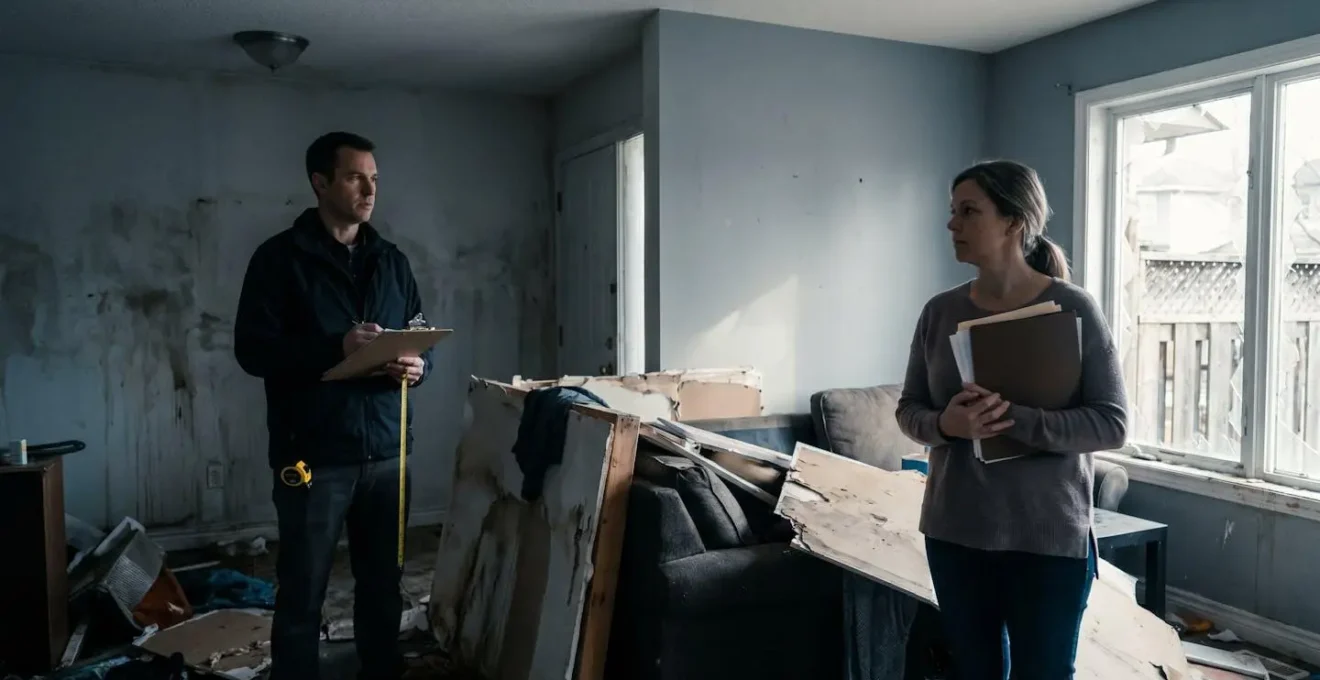
In the wake of property damage, the Loss Adjuster sent by your insurer is not a neutral expert; they are a professional paid to protect the insurer’s financial interests.
- A Loss Adjuster’s primary role is to assess the validity of a claim and minimise the payout for their employer, the insurance company.
- A Loss Assessor works exclusively for you, the policyholder, to manage your claim and ensure you receive the full settlement you are entitled to.
Recommendation: To level the playing field, you need your own professional representation. Engaging a Loss Assessor ensures your claim is valued accurately and managed expertly from start to finish.
The aftermath of a fire, flood, or significant property damage is a deeply stressful and disorienting experience. Amid the chaos, a call from your insurance company brings a sliver of hope: they are sending a « Loss Adjuster » to help. They are presented as an impartial expert, here to assess the damage and get your claim moving. This is the first, and most critical, misunderstanding in the insurance claim process. The reality is far more complex.
The Loss Adjuster works for, and is paid by, the insurance company. Their professional duty is to their employer, not to you. While they must follow ethical codes, their goal is to validate the claim and determine a settlement figure that is justifiable and, ideally, minimises the insurer’s liability. They are playing a procedural game where they know all the rules, the nuances of your policy, and the industry-standard costs—an inherent information asymmetry that puts you at a significant disadvantage from day one. You are an amateur in a professional league.
But what if the key to a fair settlement isn’t about arguing with the adjuster, but about changing the game itself? This guide will pull back the curtain on the claims process. We will explore the role of the Loss Adjuster, the standards they must follow, and the tactics you can employ to challenge their findings. Crucially, we will introduce your professional counterpart—the Loss Assessor—and demonstrate how bringing your own expert to the table is the single most effective way to ensure you are treated fairly and receive the full compensation you deserve.
This article provides a clear roadmap for navigating your insurance claim. By understanding the roles, rules, and your rights, you can move from a position of confusion and vulnerability to one of control and confidence.
Summary: Loss Adjuster vs. Loss Assessor: A Homeowner’s Guide to Fair Claims
- The First Visit: How to Prepare Your Home and Answers for the Adjuster?
- The Charter of Fairness: What Standards Must a Loss Adjuster Follow?
- No Win, No Fee: Is It Worth Paying 10% of Your Claim for Help?
- The Biased Report: What to Do if the Adjuster Ignores Evidence?
- Scope Creep: Ensuring the Adjuster Includes All Necessary Prep Work?
- Challenging the Adjuster: How to Argue That the Offer Is Too Low?
- The Appeal Letter: How to Structure Your Argument Against a Rejection?
- The First Call: What to Say (and Not Say) When Notifying Your Insurer of a Claim?
The First Visit: How to Prepare Your Home and Answers for the Adjuster?
The Loss Adjuster’s first visit is the most critical event in your claim’s early stages. They are not visiting as a sympathetic guest; they are conducting a forensic investigation. Your level of preparation directly impacts the initial tone and trajectory of your claim. An unprepared homeowner is a passive participant, relying on the adjuster’s interpretation of events and damage. A prepared homeowner, however, controls the narrative by presenting a clear, documented case. This is your first opportunity to counter the asymmetric knowledge that favors the insurer.
You must shift your mindset from victim to project manager. Your home is now a case file, and your job is to build the evidence. This means meticulously documenting everything before the adjuster arrives. Timestamped photos and videos are not just helpful; they are essential proof. An inventory of damaged items should be as detailed as a legal deposition, including dates, prices, and links to replacements. By presenting the adjuster with a well-organized file of evidence, you establish yourself as a serious and credible policyholder, making it harder for them to overlook or undervalue items.
The visual evidence you collect, as shown in the meticulous preparation above, is your primary tool. Every conversation should be backed by a document, every claim supported by a photo. During the visit, answer questions factually and concisely. Do not speculate on the cause of the loss or offer opinions on what you think is covered. Stick to the evidence you have compiled. Your goal is not to befriend the adjuster, but to provide them with the irrefutable facts needed to process your claim fully and fairly. A professional approach from you encourages a professional response.
Your Action Plan: Documenting Your Claim for the First Visit
- Compile your full insurance policy documents to have a clear understanding of your stated coverage before the adjuster’s visit.
- Gather all available proof of ownership for items that have been damaged, including any receipts, bank statements, invoices, and pre-loss photographs.
- Create a comprehensive visual record by taking timestamped videos and photographs of all affected areas before any cleaning or repair work begins.
- Prepare a detailed inventory list of damaged items, noting their description, original purchase date, price, and the estimated cost for a like-for-like replacement.
- Collect all prior correspondence with your insurer and maintain a documented record of any emergency repairs you have already undertaken to mitigate the loss.
The Charter of Fairness: What Standards Must a Loss Adjuster Follow?
It’s crucial to understand that Loss Adjusters are not unregulated agents. They operate within a framework of professional and ethical standards designed to ensure fairness and prevent abuse. These codes of conduct, often mandated by industry bodies and regulators, form a « charter of fairness » that you, the policyholder, can and should hold them to. They are expected to be impartial in their investigation, transparent in their dealings, and honest in their reporting. This is the official standard.
However, the inherent conflict in their role creates a significant grey area. As one code of ethics clearly states, the duty to be fair to the claimant is paramount. The Florida Adjuster’s Code of Ethics, for example, is unequivocal in its language about public trust, as highlighted by a commentary in Claims Law Magazine:
The work of adjusting insurance claims engages the public trust. An adjuster must put the duty for fair and honest treatment of the claimant above the adjuster’s own interests, in every instance.
– Florida Adjuster’s Code of Ethics, Claims Law Magazine – Ethical Decision-Making When Conducting Investigations
The reality is that an adjuster’s career progression and performance reviews are tied to their effectiveness for their employer—the insurer. This creates a powerful, albeit often subconscious, pressure to interpret policies narrowly, question the scope of damage, and find justifications for reducing the claim value. They are not necessarily acting in « bad faith, » but they are operating under a set of incentives that are not aligned with yours. Understanding this distinction is key: you are not accusing them of being unethical, you are simply acknowledging the structural bias of their role. Your protection lies in knowing their rulebook better than they expect you to.
No Win, No Fee: Is It Worth Paying 10% of Your Claim for Help?
When you are facing a significant loss, the idea of giving away a portion of your settlement can seem counterintuitive. Loss Assessors, the professionals who work exclusively for you, typically operate on a ‘No Win, No Fee’ basis. Their fee is a percentage of the final claim settlement, which means their success is directly tied to yours. While this percentage can vary, a common figure is around 10% of the total claim value. For many homeowners, the pivotal question is: is it worth it?
The simple answer is that a Loss Assessor is not a cost; they are an investment. You are not paying for someone to simply fill out forms. You are hiring a professional to level the playing field. They bring the same level of policy knowledge, negotiation skill, and industry experience as the Loss Adjuster, but their expertise is deployed for your benefit. They meticulously build your case, identify hidden costs, and argue every point from a position of strength. According to industry experts Harris Balcombe, loss assessors typically charge up to 10%, but the return on this investment is often substantial.
Case in Point: The Value of Professional Representation
Consider a major house fire, a scenario where damage is complex and often hidden. As highlighted in guidance from MoneySavingExpert, this is precisely where an assessor proves their worth. The insurer’s adjuster may produce an initial offer based on a superficial assessment, aiming to close the file quickly. A Loss Assessor, in contrast, will manage the entire process, commissioning specialist reports to uncover the full extent of structural, smoke, and water damage. While their fee is a percentage of the settlement, their involvement frequently leads to significantly higher payouts that not only cover their fee but also provide thousands more for a proper rebuild, especially when insurers might otherwise use tactics to minimise the claim.
The value proposition becomes even clearer when you look at the numbers. An assessor’s ability to professionally document and argue a claim can lead to a dramatically different outcome. As one industry analysis points out, the financial uplift can be significant.
It is common for a Loss Assessor to secure a 20 – 30% increase on an Insurance Company’s settlement offer.
– Property Saviour, Loss Assessor vs Loss Adjuster: The Brutal Truth Revealed
This increase doesn’t come from thin air. It comes from a professional, detailed, and comprehensive approach to valuing your loss—something a distressed homeowner can rarely achieve alone.
The Biased Report: What to Do if the Adjuster Ignores Evidence?
One of the most frustrating moments for a policyholder is receiving the Loss Adjuster’s report and finding it incomplete or biased. You may discover that key evidence you provided has been ignored, damage has been downplayed, or policy clauses have been interpreted in the narrowest possible way to limit the payout. This is not just a disagreement; it’s a direct challenge to the fairness of your claim. At this point, an emotional response is understandable but ineffective. A strategic, documented, and escalating response is required.
Your first step is to formally request a copy of the adjuster’s report. You have a right to see the basis of their decisions. Scrutinise it line by line against your own documentation. Where are the discrepancies? What has been omitted? Your goal is to build a rebuttal, not just a complaint. This rebuttal should be a professional document that methodically addresses each point of disagreement, referencing your own evidence (photos, quotes, expert opinions) and cross-referencing specific clauses in your policy. You are moving the conversation from « I feel this is unfair » to « Here is the evidence you have overlooked, which contradicts your finding X, and is covered under policy section Y. »
As industry veterans Harris Balcombe Loss Assessors note, the adjuster’s report is a powerful tool for the insurer. A report that highlights gaps or inconsistencies can be devastating. This is why a methodical escalation is crucial if your initial rebuttal is ignored. You must move up the chain of command, from the adjuster to their manager, and then to the insurer’s Head of Claims. If the dispute is about valuation, you may need to commission your own independent reports from surveyors or engineers to create a powerful counter-assessment. This is a battle of paperwork, and the side with the most comprehensive, professional documentation usually prevails.
Your Action Plan: Escalating a Disputed Report
- Formally request and obtain a full copy of the Loss Adjuster’s findings report to review their assessment in detail.
- Thoroughly review the report to pinpoint all discrepancies, omissions, and undervalued items compared to your own evidence.
- Compile and submit a formal rebuttal package that addresses each point of disagreement, supported by your evidence and referenced against the adjuster’s code of conduct.
- If the initial resubmission fails, escalate the matter in writing to the adjuster’s direct manager and, if necessary, the insurer’s Head of Claims.
- For technical disputes, commission an independent third-party expert, such as a surveyor or engineer, to produce a counter-assessment report.
Scope Creep: Ensuring the Adjuster Includes All Necessary Prep Work?
A common tactic for minimizing a claim’s value is to create an overly narrow « Scope of Work. » The Loss Adjuster might agree to replace a damaged wall, but what about the cost of dust protection for the rest of the house? They might approve the cost of new flooring, but omit the cost of moving and storing your furniture while the work is done. These are « consequential damages » or enabling works, and they are a legitimate and essential part of the claim. The battle for a fair settlement is often won or lost on the completeness of this scope.
The initial damage is often just the tip of the iceberg. A professional assessment, like one a Loss Assessor would conduct, looks beyond the obvious. It considers the entire process of making your home whole again. This includes everything from initial safety measures and debris removal to final professional cleaning. It also accounts for modern building codes, which may require upgrades to systems like electrical or plumbing that were not part of the original construction, but are now mandatory for any new work. These are non-negotiable costs required to complete the repair, and they must be included.
As the image above suggests, what you see on the surface is often not the full story. Water damage can lead to hidden mold growth, and a small fire can cause extensive smoke damage within wall cavities and HVAC systems. A superficial scope will never account for this. You must proactively question the adjuster’s scope. Ask them directly: « Does this scope include costs for professional cleaning? For code compliance? For matching materials in the adjoining room to ensure a consistent finish? » If these items are missing, the proposed settlement is incomplete. The true scope of loss is not just the repair itself, but the entire project of restoration.
Challenging the Adjuster: How to Argue That the Offer Is Too Low?
Receiving a low settlement offer can feel like a final insult after the injury of your initial loss. But it’s critical to understand that the first offer is rarely the final offer. It is an opening bid in a negotiation you may not have realised you were in. To effectively challenge it, you must move beyond emotion and build a counter-offer based on facts, data, and professional documentation. Simply stating « it’s not enough » will get you nowhere. You need to demonstrate *why* it’s not enough, line by line.
The first step is to demand a detailed breakdown of the settlement. An unitemised, lump-sum offer is a red flag; it prevents you from seeing how they valued—or undervalued—each component of your loss. Once you have the breakdown, you can begin your counter-offensive. The most powerful tool in this process is obtaining competing quotes from reputable, independent contractors. For maximum impact, these quotes should be prepared using the same estimating software the insurance industry uses, such as Xactimate. This creates a true « apples-to-apples » comparison that is difficult for the adjuster to dismiss.
Your counter-offer should be presented as a professional package. It should include a cover letter that outlines your position, the adjuster’s itemised offer, your competing quotes, and all supporting evidence like photographs and expert reports. Throughout this process, maintain a meticulous paper trail. Every phone call with the adjuster should be followed up with an email summarising the conversation: « To confirm our discussion today… » This creates an accountability trail and prevents miscommunication. Remember to use diplomatic language. You are not accusing them of bad faith (even if you suspect it); you are engaging in a professional process to ensure transparency and accuracy. It’s a common situation; indeed, The Association of British Insurers estimates that around 20% of major household claims involve this level of contention where professional help is sought.
Key takeaways
- The Loss Adjuster works for the insurer, not you. Their primary duty is to their employer.
- Thorough documentation is your most powerful tool. Photograph, video, and inventory everything before the adjuster’s first visit.
- A fair settlement must include the full « Scope of Loss, » including all preparatory work, cleaning, and code-required upgrades.
The Appeal Letter: How to Structure Your Argument Against a Rejection?
If your claim is partially or fully rejected, or if the insurer refuses to negotiate a low offer, your next formal step is a written appeal. This isn’t the time for an angry, rambling email. A successful appeal letter is a structured, logical, and evidence-based legal argument. It should be so clear and well-supported that it makes it easier for the insurer to approve your claim than to continue fighting it. A highly effective structure for this is the IRAC method, borrowed from legal practice: Issue, Rule, Application, Conclusion.
First, Issue: State clearly and concisely what you are appealing. Include your name, policy number, claim number, and the specific decision you are contesting (e.g., « the denial of coverage for roof replacement dated January 5, 2024 »). Second, Rule: This is where you cite the insurance policy itself. Quote the exact language from the policy section that provides coverage for your loss. Include the page and section numbers. This demonstrates that you have read your policy and are basing your appeal on its contractual terms. Third, Application: This is the longest section. Here, you connect the « Rule » (your policy) to the « Issue » (your damage) by presenting your evidence. Lay out your facts chronologically. Refer to your enclosed evidence: « As shown in the attached engineer’s report (Exhibit A)… », « The photograph dated… (Exhibit B) clearly shows… ».
Finally, Conclusion: Restate your request in a single, clear sentence. « Therefore, we request a reversal of the denial and full payment of our claim in the amount of £X, as detailed in the contractor’s estimate (Exhibit C). » You should also state a reasonable deadline for their written response (e.g., 30 days). This professional, methodical approach can be highly effective. While it may seem daunting, it is far from a hopeless exercise. In fact, research shows that 30-40% of insurance claim appeals are successful. Structuring your argument professionally is the key to falling into that winning percentage.
The First Call: What to Say (and Not Say) When Notifying Your Insurer of a Claim?
The moment you pick up the phone to notify your insurer of a loss, the « procedural game » begins. Every word you say can, and likely will, be noted in your file. This first call sets the initial record of the event, and any inconsistencies later on can be used to question your credibility. It is absolutely vital to be prepared and disciplined in this first communication. Your goal is to report the loss and initiate the claim, nothing more.
The cardinal rule is to stick to the facts. Provide concise, factual information: who you are, your policy number, the location of the property, and the date and type of loss (e.g., « fire, » « water damage »). Do not speculate on the cause. Do not estimate the cost of the damage. Most importantly, never apologize or minimize the damage with phrases like « it’s not too bad » or « I think it was my fault. » These innocent comments can be interpreted as admissions that limit the insurer’s liability. You are not an expert investigator or a structural engineer; your job is not to analyse the cause, only to report the effect.
This call is also your first opportunity to establish your rights and expectations. You must ask the critical questions: « What are my immediate obligations for mitigating further loss? » and « What is my coverage for emergency repairs or temporary accommodation? » This shows you are a responsible policyholder while also getting crucial information. Before hanging up, create a verbal record by confirming the claim number you’ve been given and the expected timeline for the adjuster’s contact. Finally, state your communication preference clearly: « Please note in the file that I require all offers, scopes of work, and official decisions to be sent to me in writing. » This establishes a paper trail from the very beginning. This first, disciplined conversation is the foundational move in protecting your interests throughout the entire claims process.
Mastering this first contact is the opening move, but as this guide has shown, the entire claims process is a complex journey with numerous potential pitfalls. From documenting the loss and scrutinising the scope of work to challenging a low offer and structuring an appeal, each stage requires expertise, diligence, and a deep understanding of the rules. You can attempt to learn this complex game while under the extreme stress of a major loss, or you can bring in a professional to play for your team. Engaging a Loss Assessor is the surest way to level the playing field and ensure your financial recovery is as complete as the restoration of your home.