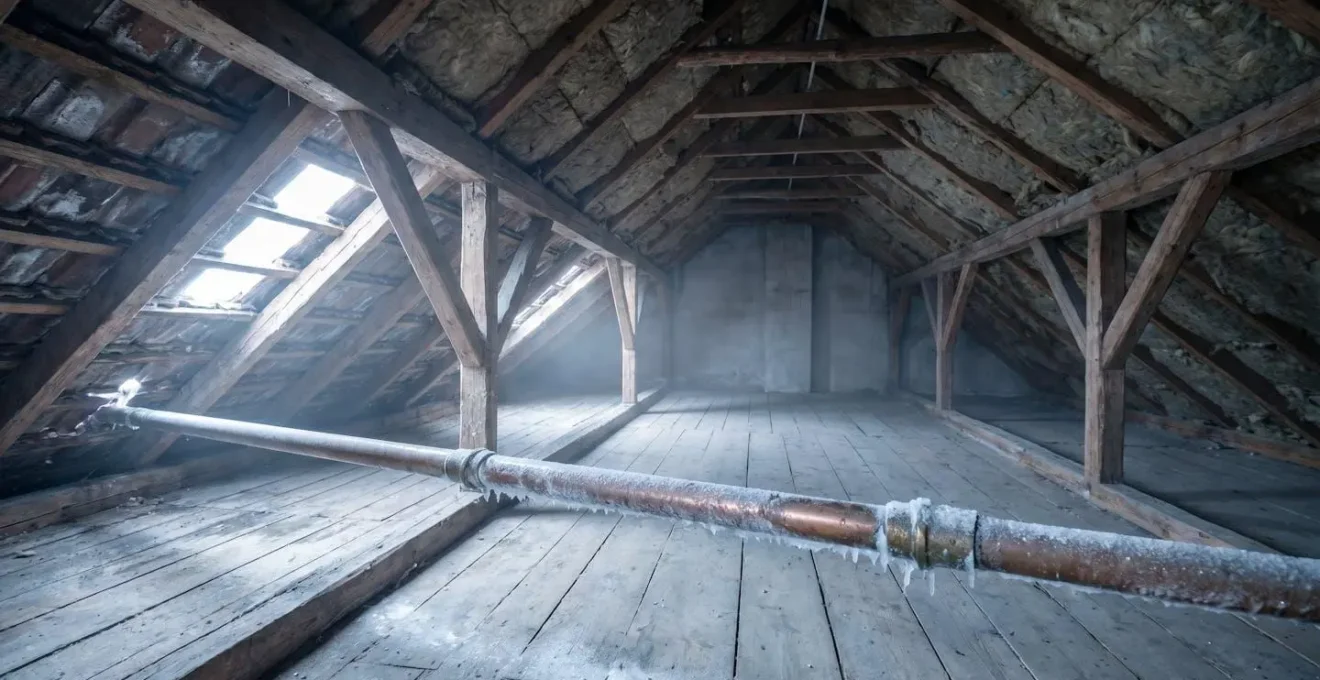
Turning off your heat to save money while on holiday is the fastest way to have a burst pipe claim denied.
- Insurers require you maintain a minimum temperature, often around 12-13°C (55°F), as a basic condition of your policy.
- Proving you took active, ‘reasonable’ steps to prevent freezing—and documenting them—is your responsibility, not the insurer’s.
Recommendation: Before you leave, check your policy’s specific temperature clause and either set your thermostat accordingly or arrange for a complete system drain for total protection.
The bags are packed for that long-awaited two-week ski trip. The final checklist is being ticked off: windows locked, mail held, pets with the sitter. There’s just one last thing to do before walking out the door—adjust the thermostat. The temptation to turn it off completely to save on the heating bill is strong. It feels like a smart, economical move. After all, nobody will be home. But this is precisely the kind of « smart » decision that can lead to a financial catastrophe.
What you consider a simple cost-saving measure, your insurance company views through the cold lens of risk and responsibility. In the event of a sudden cold snap, that silent, empty house is a prime candidate for frozen, burst pipes. And when the water damage claim lands on their desk, the first thing they will investigate is not the pipe itself, but the choices you made before you left. That small saving on your utility bill could become an uninsured gamble, potentially invalidating your entire policy and leaving you with a bill that can easily top tens of thousands of dollars.
This guide goes beyond the generic advice to « insulate your pipes. » It’s a deep dive into the language and expectations of your insurance policy. We will deconstruct the critical clauses—from minimum temperatures to the all-important concept of ‘reasonable care’—that determine whether your claim for winter water damage gets approved or denied. Understanding these rules is the only way to turn your holiday from a financial risk into a well-deserved, worry-free escape.
To navigate the complexities of your insurance policy and protect your home this winter, we will explore the specific conditions and common failure points that every homeowner must understand. This article breaks down exactly what you need to know.
Summary: The Homeowner’s Guide to Winter Insurance Coverage
- Is 12 Degrees Enough? The Minimum Temperature Required to Validate Your Policy?
- Draining the System: The Only 100% Guarantee Against Frozen Pipes in Empty Homes?
- Lagging the Loft: Why Uninsulated Pipes in the Roof Are a Ticking Time Bomb?
- Thawing Out: The Dangerous Mistake That Cracks Pipes As They Warm Up?
- The Washer That Fails: Why Plastic Push-Fit Connectors Pop in Freezing Conditions?
- How to Keep Your Holiday Home Covered During the Winter Shutdown?
- Minimum Temperature Clauses: Must You Keep Heating at 15°C All Winter?
- The ‘Reasonable Care’ Clause: How Leaving Windows Open Voids Your Theft Claim?
Is 12 Degrees Enough? The Minimum Temperature Required to Validate Your Policy?
The single most critical question to answer before you leave is not « how low can the heat go? » but « what temperature does my policy demand? » Many homeowners are shocked to discover that their insurance contains a specific « minimum temperature clause. » This isn’t a suggestion; it’s a condition of coverage. Ignoring it is tantamount to voiding your policy for any claim related to freezing. While specifics vary, most homeowners insurance policies mandate maintaining indoor temperature at a minimum of 55°F (around 13°C).
Setting your thermostat to 12°C (54°F) might seem close enough, but an insurer may see it as a failure to comply. The goal isn’t just to keep pipes from freezing but to demonstrate you’ve taken deliberate, « reasonable » steps. The financial stakes are immense. When a pipe does burst, the damage is rarely minor. Water can saturate floors, walls, and foundations, leading to structural issues and mold growth. It’s no surprise the average insurance claim for a frozen pipe incident exceeds $30,000, according to State Farm data.
Before your trip, your first action should be to pull up your policy documents and search for terms like « vacant, » « unoccupied, » « heat, » or « freezing. » Find the exact temperature required. If you can’t find a specific number, the safest bet is to maintain a temperature of at least 13°C (55°F) and document it by taking a dated photo of your thermostat setting before you leave. This simple act can become your most valuable piece of evidence in a claim dispute.
Draining the System: The Only 100% Guarantee Against Frozen Pipes in Empty Homes?
While maintaining heat is the most common strategy for preventing frozen pipes, it relies on several factors you can’t control while on holiday: a continuous power supply, a functioning furnace, and a stable fuel source. A power outage during a blizzard or a sudden furnace malfunction can render your thermostat setting useless. For homeowners leaving for an extended period, especially in extremely cold climates, there is a more definitive solution: draining the entire water system.
If there is no water in the pipes, there is nothing to freeze, expand, and cause a rupture. This is the only method that provides a 100% guarantee against burst pipes. While it requires more effort upfront, it completely removes the risk of a heating system failure leading to catastrophic water damage. It is a particularly wise choice for holiday homes or properties that will be unoccupied for the entire winter season. An insurer will view a properly drained system as the highest level of « reasonable care. »
The process involves more than just shutting off the main water valve. To be effective, every drop of water must be removed from the plumbing system, including appliances, toilets, and drain traps, which can otherwise hold water that may freeze and crack the fixture. It’s a thorough task, but one that provides complete peace of mind, knowing your home is immune to the primary cause of winter water damage.
Your Action Plan: Draining The System For Winter
- Shut off the main water supply to your house.
- Open all faucets (hot and cold) to drain all pipes throughout the plumbing system.
- Drain all domestic appliances, such as washing machines and dishwashers, following manufacturer instructions.
- Flush toilet cisterns and bowls to remove all standing water.
- Pour a non-toxic plumbing antifreeze into all U-bends and drain traps under sinks and in floor drains to prevent them from freezing and cracking.
Lagging the Loft: Why Uninsulated Pipes in the Roof Are a Ticking Time Bomb?
Heat rises. This simple principle of physics means that while your living room thermostat might read a comfortable 15°C, the unheated, uninsulated spaces of your home—like the attic, crawl spaces, or garage—can be significantly colder, often dropping below freezing. Pipes running through these areas are the most vulnerable. Insulating your loft floor keeps warmth in the rooms below, but it also makes the loft itself colder, turning any exposed plumbing into a high-risk zone.
This risk is not hypothetical. A comprehensive study of 433 burst pipe claims identified unheated attics as the most common location for pipe failures. These pipes are a ticking time bomb because they are often out of sight and out of mind, subjected to the harshest temperatures in the house without the benefit of ambient warmth from living spaces.
The solution is pipe lagging—fitting foam insulation tubes around the pipes themselves. This is a simple, inexpensive DIY task that provides a crucial thermal barrier. It doesn’t add heat, but it dramatically slows the rate at which the water inside the pipe loses heat, often providing enough protection to prevent freezing during a cold night or a brief power outage. When an insurance adjuster investigates a claim, evidence of poorly insulated or completely un-lagged pipes in vulnerable areas can be used to argue you failed to take reasonable preventive measures.
Thawing Out: The Dangerous Mistake That Cracks Pipes As They Warm Up?
It’s a common misconception that pipes burst when the water inside them freezes solid. The initial freezing process itself is only part of the story. When water turns to ice, research shows that it increases in volume by approximately 9%. This expansion creates immense pressure inside the pipe. The actual rupture, however, often occurs during the thaw.
The problem arises from what is essentially a pressure blockage. As a section of the pipe freezes, it creates an ice plug. Continued freezing expands this plug, compressing the trapped water between the ice and a closed faucet downstream. The pressure builds to an extreme level—thousands of pounds per square inch—far exceeding what the pipe (whether copper or plastic) can handle. The pipe splits. At this point, it’s still frozen, so no water leaks. The real disaster begins when the temperature rises and the ice plug melts. Water, now under full municipal pressure, begins gushing from the newly exposed crack.
This is why a homeowner might return from a trip to find everything seems fine, only to have a flood begin hours later as the house warms up. Attempting to rapidly thaw a frozen pipe with a blowtorch or open flame is another dangerous mistake. The intense, localized heat can cause a thermal shock, cracking the metal, or instantly turn the ice plug into steam, creating a pressure explosion. The safest way to thaw a pipe is with gentle, even warmth, like a hairdryer on a low setting or towels soaked in hot water.
Case Study: The Reversed Denial
A restaurant owner in North Carolina faced a nightmare scenario when a burst pipe flooded his business. His insurer initially denied the entire six-figure claim, citing « poor maintenance. » However, by hiring experts, the owner proved the burst was caused by a sudden, uncontrollable pressure surge from the city’s main water line—not negligence. This case demonstrates the critical importance of proving the true cause of failure, as insurers may initially look for any reason to deny a claim. The denial was ultimately reversed, and the owner received a full settlement.
The Washer That Fails: Why Plastic Push-Fit Connectors Pop in Freezing Conditions?
Modern plumbing has increasingly adopted plastic components, including PEX pipes and push-fit connectors, for their flexibility and ease of installation. While generally reliable, these components have their own unique vulnerabilities in freezing conditions. The biggest issue with plastic push-fit connectors is not necessarily the plastic itself, but the small rubber O-ring or « washer » that creates the watertight seal.
When water inside the connector freezes, the expanding ice exerts pressure in all directions. While a copper pipe might split along its length, a push-fit connector is more likely to fail at its weakest point: the seal. The ice can deform the O-ring, push the pipe out of the fitting, or even crack the plastic housing of the connector itself. These connectors are often used in tight, hard-to-reach places, making them difficult to inspect and insulate properly.
The consequences of such a small component failing can be disproportionately large. It’s a stark reminder that the integrity of your entire plumbing system is only as strong as its weakest link. Even a minuscule crack can lead to a deluge. To put it in perspective, a tiny 1/8-inch crack (about 3mm) in a pipe can release up to 250 gallons of water per day. That’s enough to fill five standard bathtubs, every single day, until the water is shut off. When this happens in an unoccupied house, the damage escalates exponentially, turning a small part failure into a full-scale renovation project.
How to Keep Your Holiday Home Covered During the Winter Shutdown?
For those with a second home or a holiday cabin that sits empty for long stretches of winter, the insurance stakes are even higher. Insurers view « unoccupied » properties as a greater risk, not just for freezing but also for theft, vandalism, and undetected damage. As a result, policies for these homes often have stricter and more explicit requirements for winter maintenance. Simply locking the door and hoping for the best is not an option.
Your policy is a contract, and that contract requires you to act responsibly. As the DC Department of Insurance, Securities and Banking clarifies in its official guidance, the expectation is clear. They state:
Your policy usually requires that heat be maintained within the property, and some policies require that you maintain a certain temperature, even if the property is vacant, occupied or unoccupied.
– DC Department of Insurance, Securities and Banking, Official guidance on frozen pipe insurance coverage
The best strategy involves technology and planning. Installing a smart thermostat allows you to monitor and control your home’s temperature remotely from your phone. You can receive alerts if the temperature drops below a pre-set level, indicating a potential power or furnace failure, giving you time to react. Similarly, water leak detectors or a full smart water shut-off system can provide an invaluable early warning. Documenting that you have these systems in place is powerful evidence of « reasonable care. »
Alternatively, if the property will be vacant for the entire winter, performing a complete system drain (as detailed previously) is the most robust solution. Whichever path you choose, you must inform your insurance agent of your plans. Open communication and adherence to their specific winterization requirements are essential to ensuring your coverage remains valid.
Minimum Temperature Clauses: Must You Keep Heating at 15°C All Winter?
The fear of a denied claim often leads homeowners to ask: do I really have to keep the heat cranked to 15°C (60°F) all winter just to satisfy my insurer? The answer is nuanced. While a higher temperature is always safer, the specific requirement in your policy is what truly matters. As we’ve seen, many policies stipulate a minimum of 13°C or 55°F. Going above that is a buffer, not necessarily a mandate.
The core of the issue is not about maintaining a specific temperature at every single moment, but about demonstrating responsible behavior. A power outage is usually not considered the homeowner’s fault. The controlling question is whether you took reasonable steps under the circumstances. As legal experts analyzing these clauses point out, the burden of proof is about intent and preparation, not guaranteeing a perfect outcome.
This perspective is essential for understanding your obligations. As one legal analysis puts it:
The policy typically does not require you to guarantee that heat was maintained at every moment. Instead, the controlling question is whether you exercised reasonable care under the circumstances.
– WDB Legal, Legal analysis of ‘reasonable care’ insurance requirements
So, what does this mean in practice? It means setting your thermostat to a compliant temperature (e.g., 13°C) is your primary duty. Additionally, you should ensure your heating system has been recently serviced, your home is adequately insulated, and you have a plan for extended absences. If you’ve done all this and a pipe still freezes due to an « act of God » like a multi-day blizzard-induced power failure, you are in a much stronger position to argue your claim. You didn’t guarantee the heat would stay on, but you did everything a reasonable person would to maintain it.
Key Takeaways
- Minimum Heat is Non-Negotiable: Most insurance policies are at risk of being void for freeze-related claims if the interior temperature drops below 12-13°C (55°F).
- Proof of Action is Your Responsibility: Simply saying you left the heat on isn’t enough. Documenting your preventive measures with photos of thermostat settings or receipts for pipe lagging is crucial evidence.
- ‘Reasonable Care’ is the Ultimate Test: Insurers will use this broad clause to judge your overall effort. Obvious negligence, like leaving a window open or failing to insulate known problem areas, can void an otherwise valid claim.
The ‘Reasonable Care’ Clause: How Leaving Windows Open Voids Your Theft Claim?
The « reasonable care » clause is one of the most powerful and ambiguous tools in an insurer’s arsenal. It’s a catch-all condition that requires you, the policyholder, to take prudent steps to prevent loss. While this article focuses on burst pipes, the principle applies to all claims. For example, leaving a ground-floor window open while on holiday would almost certainly lead to a denied theft claim, as it demonstrates a clear lack of reasonable care. The same logic applies to winterizing your home.
Failing to maintain heat, not insulating pipes in a known cold attic, or not fixing a furnace that you know is faulty can all be interpreted as a failure to exercise reasonable care. The burden of proof in these disputes lies with you, the homeowner. You must be able to demonstrate that you took a series of logical, documented steps to protect your property. This can be challenging, as court cases have shown.
For instance, the notable Zimmerman case involved a homeowner who presented a strong record: the vacant home was insulated, the heating system was working, and thermostats were set to 55°F. Yet, the claim was still debated because contradictory evidence emerged about a potential boiler malfunction and the exact duties of a realtor monitoring the property. The case underscores that even with good preparation, proving you met the ‘reasonable care’ standard is a complex, case-by-case battle. It reinforces the need for meticulous documentation of every preventive action you take.
Ultimately, ‘reasonable care’ means thinking like an insurer. Before you leave, walk through your home and ask: « If something goes wrong, what could I be accused of neglecting? » Address those points proactively. Service the furnace, lag the pipes, set the thermostat to a safe level, and take a photo. This isn’t just home maintenance; it’s building your legal defense in advance.
Before you lock the door for your holiday, take 30 minutes to review your policy, set your thermostat to at least 13°C (55°F), and take a dated photograph as proof. This simple, deliberate act is the difference between a relaxing vacation and a potential financial catastrophe. Your home is your biggest investment; protecting it with a few careful steps is the smartest financial decision you can make.