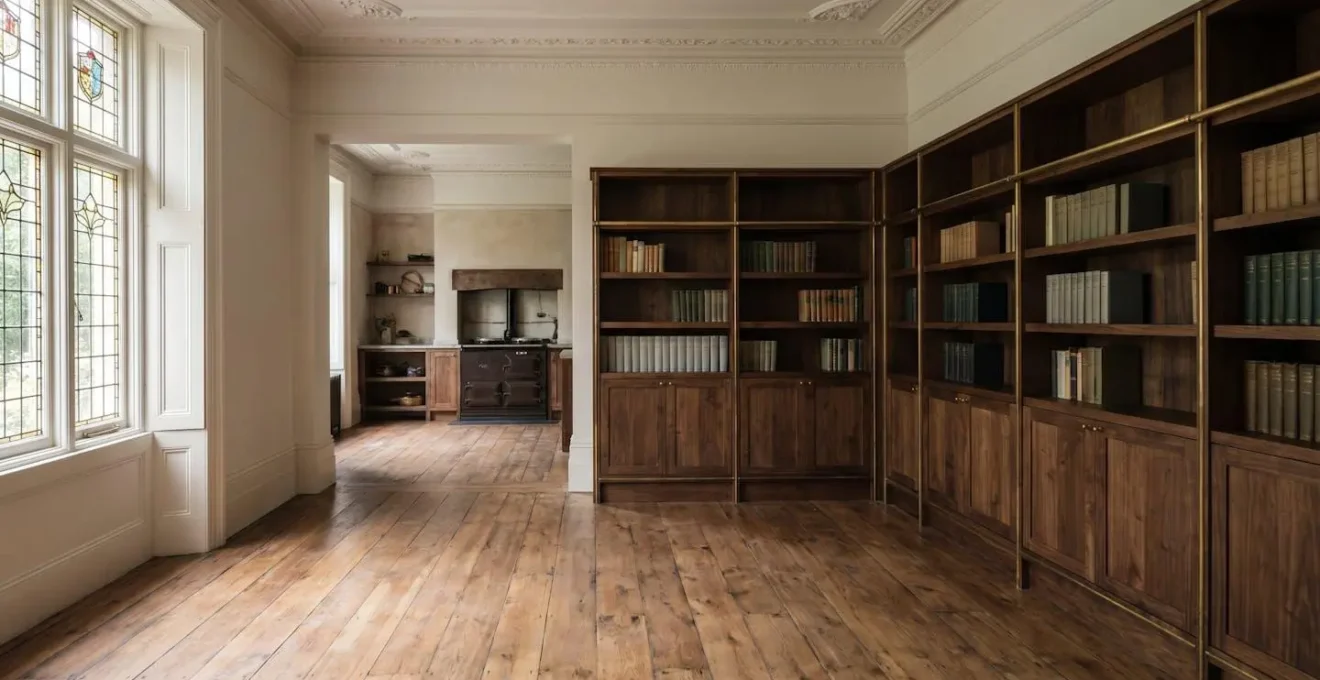
The common « upside-down house » rule for insurance is a dangerously expensive myth for owners of high-value properties; true coverage hinges on proving your bespoke installations are legally part of the ‘building’.
- Standard policies rely on vague definitions that can classify a £30,000 kitchen as simple ‘contents’, leading to significant underinsurance.
- Insurers look for evidence of permanence—physical integration and damage upon removal—to differentiate a fixture from a fitting.
Recommendation: Proactively build a dossier for each high-value fixture, including installer contracts and photographs, to force its correct classification as part of the ‘building’ and ensure full replacement cost coverage.
As the owner of a residence distinguished by its character and quality, you understand that value resides in the details. The hand-built library, the integrated smart home system, the Aga cooker that forms the heart of your kitchen—these are not mere possessions. Yet, a fundamental misunderstanding of how the insurance industry operates places these very assets at profound risk. Most homeowners, even those with high-net-worth policies, rely on simplistic rules of thumb, believing their coverage is absolute.
The conventional wisdom often cited is the ‘contents vs. buildings’ test: if you were to turn your house upside down, whatever falls out is ‘contents’. This is a fallacy. For bespoke, high-value installations, this oversimplification can lead to claim denials or settlements that are a fraction of the true replacement cost. The insurer’s assessment is far more nuanced, forensic, and, at times, archaic. They are not looking at your home; they are looking at their policy wording.
The key to securing your property’s unique features is not simply to increase your ‘sum insured’. The true strategy lies in shifting your mindset from that of a homeowner to that of an underwriter. It is about understanding the insurer’s logic—the ‘permanence test’—and proactively providing indisputable evidence that your fixtures are integral to the structure of the building itself. This is not about hoping for the best at the point of a claim; it is about eliminating ambiguity from the outset.
This guide will deconstruct the common traps and provide a strategic framework for ensuring your most valuable permanent fixtures are correctly classified and fully protected, moving beyond generic advice to offer the specific insights needed to safeguard your investment.
Summary: A Strategic Guide to Insuring High-Value Home Fixtures
- How to Ensure Your Hand-Built Library Is Covered at Replacement Cost?
- Wired-In Smart Tech: Is Your Integrated Sound System Part of the Building?
- Stained Glass and Sash Windows: The Cost of Replacing Period Features
- Silicone Sealant Failure: Why Insurers Reject Claims for Slow Leaks Behind Fixtures?
- Power to the Shed: Are the Electrics in Your Home Office Covered?
- Fine Art at Home: Why Standard ‘Contents’ Won’t Cover a Damaged Oil Painting?
- Why Carpets Are ‘Contents’ but Laminate Is Often ‘Buildings’ in the UK?
- The Single Item Limit Trap: When to ‘Specify’ Your Jewellery on the Policy?
How to Ensure Your Hand-Built Library Is Covered at Replacement Cost?
A bespoke, floor-to-ceiling library or a custom-fitted kitchen from a high-end designer is an architectural asset, not a simple piece of furniture. However, insurers may default to classing such installations as ‘fittings’ (contents) unless you prove otherwise. This distinction is critical. A ‘contents’ classification subjects the item to single-item limits and a depreciated market value, which is wholly inadequate for bespoke joinery. For high-end fitted kitchens worth £30,000 or more, this ambiguity presents a significant financial risk.
The objective is to establish, beyond doubt, that the fixture is a permanent part of the building’s fabric. This is achieved by demonstrating its integration and the damage its removal would cause to the property’s structure. Your policy’s ‘sum insured for buildings’ must reflect the full replacement cost of these items, including the cost of materials, specialist artisan labour, and installation. This figure is often significantly underestimated.
Proactive documentation is your most powerful tool. Before a loss ever occurs, you must build a comprehensive file for your insurer that proves both the value and the permanence of the fixture. This is not merely a valuation certificate; it is a dossier that makes the case for the fixture’s classification as part of the ‘building’, ensuring any potential claim is settled at full replacement cost, not a depreciated value.
Action Plan: Documenting Custom Fixtures for Valuation
- Wall trim and custom molding: Document crown molding, pilasters, arched doorways, and unique joinery techniques with close-up photography.
- Built-in cabinetry: Provide detailed descriptions of kitchen or library cabinetry materials, countertops, backsplashes, and custom hardware.
- Specialty installations: Include information about integrated lighting systems, rolling ladders, custom brass fixtures, and bespoke installation costs.
- Professional documentation: Give your insurance agent pictures or videos showing construction phases, artisan contracts, and wood sourcing receipts.
Wired-In Smart Tech: Is Your Integrated Sound System Part of the Building?
The modern luxury home is increasingly defined by its integrated technology. From multi-room audio systems with in-wall speakers to centralized lighting and security networks, these systems are designed to be seamless. This very seamlessness creates a significant insurance ambiguity. Is your wired-in sound system a high-tech piece of ‘contents’, like a television, or is it an integral part of the ‘building’s’ electrical system?
The answer lies in what underwriters call the ‘permanence test’. This test assesses the degree of physical integration. If speakers are cut into plasterboard, if custom cabinetry is built around control units, and if wiring is chased into walls, you have a strong argument that the system is a permanent fixture. Conversely, if components are simply plugged in, they will almost certainly be treated as contents, subject to lower limits and depreciation.
The evidence of professional installation is paramount. Certificates from certified electricians, detailed invoices specifying the invasive nature of the work, and architectural plans showing the system’s integration are crucial pieces of documentation that can sway an insurer’s classification in your favour.
Case Study: The Smart Home System Failure
A homeowner’s claim for water damage caused by a failed smart-home system highlighted this very issue. Insurance experts emphasize that establishing permanence through customization is critical. Because the drywall was cut and custom cabinetry was built around the system, it strengthened the classification as ‘buildings’ rather than ‘contents.’ The homeowner’s ability to produce professional installation warranties and electrician certificates proved powerful evidence against claim rejection, demonstrating the system was an integral part of the property.
Stained Glass and Sash Windows: The Cost of Replacing Period Features
For owners of period properties, features like original stained glass, hand-carved mouldings, or traditional sash windows are not just functional; they are the essence of the home’s character and value. However, standard insurance policies are ill-equipped to handle their loss. A typical policy calculates replacement based on modern, mass-produced equivalents—a devastating mismatch when a single, custom-made sash window can cost thousands to replicate using heritage techniques and materials.
This is where the concept of ‘replacement cost’ requires forensic attention. Your buildings’ sum insured must not be based on the property’s market value but on the genuine cost to rebuild it from the ground up, including the cost of sourcing specialist artisans and materials to replicate its unique features. Failing to account for this can leave a catastrophic gap in coverage. An insurer might offer to replace a damaged, unique Victorian tiled hallway with standard modern tiles, a solution that is contractually sound for them but a disaster for you.
To avoid this, period features must be explicitly discussed with your insurer or broker. Professional valuations should be sought not from a standard surveyor, but from a firm specializing in heritage properties. These valuations, complete with detailed photographs and descriptions of the features, form the basis of an ‘agreed value’ for these specific items, removing ambiguity long before a claim is necessary.
A standard building insurance policy may cover a typical kitchen, but not a high-end fitted kitchen like a Roundhouse or deVOL installation worth £30,000 or more. Always make sure your sum insured reflects the true replacement costs of what you’ve installed.
– Lemonade UK, Insurance guidance on bespoke installations
Silicone Sealant Failure: Why Insurers Reject Claims for Slow Leaks Behind Fixtures?
One of the most common and contentious areas for insurance claims is water damage. While a sudden burst pipe is usually covered, the insidious damage from a slow, undetected leak is often rejected under a ‘gradual damage’ exclusion. For owners of high-value homes with bespoke bathrooms and kitchens, this presents a major threat. A tiny failure in a silicone seal behind a marble-clad wall or custom vanity unit can lead to catastrophic rot and mould, the repair of which requires dismantling the very fixtures you’ve sought to protect.
Insurers argue that gradual damage is a maintenance issue, not an insurable event. Indeed, industry data shows that nearly 1 in 10 water damage claims are rejected, often on these grounds. However, the application of this exclusion is not always straightforward. The critical distinction often hinges not on the speed of the leak, but on the moment of reasonable discovery. If the damage was occurring in a place you could not possibly see or access—such as behind a permanently fixed bath panel or within a wall cavity—you may have grounds to challenge a rejection.
The key is how you frame the claim. It is not a claim for a ‘slow leak’; it is a claim for the ‘sudden and unforeseen discovery’ of damage. Your responsibility is to act immediately upon discovering the issue and to notify your insurer without delay. Documenting the hidden nature of the leak’s source with photographs and reports from plumbers is vital evidence.
Case Study: The Gradual Damage Dispute
In a case reviewed by the Financial Ombudsman, a homeowner’s claim for a damaged ceiling was initially declined due to ‘gradual damage’. The Ombudsman, however, emphasized a key distinction. Even when damage is concealed behind fixtures like kitchen units, if the policyholder makes the claim as soon as they could have reasonably known about the problem, insurers may be required to pay. The deciding factor was not the slow leak itself, but the homeowner’s prompt action upon its sudden discovery.
Power to the Shed: Are the Electrics in Your Home Office Covered?
The rise of the high-specification garden office or outbuilding has introduced a new layer of complexity to home insurance. These are no longer simple sheds; they are often fully insulated, climate-controlled structures with dedicated power, data lines, and significant investment in fixtures and technology. The question of whether this valuable extension of your home is adequately covered is critical.
Most standard home insurance policies include a small, often overlooked, sub-limit for outbuildings, typically around £2,500-£5,000. This is glaringly insufficient for a custom garden office that could be worth £50,000 or more. You must verify this limit and, if necessary, arrange for a specific extension of your ‘buildings’ coverage to include the full replacement value of the structure.
Furthermore, the use of the building can invalidate coverage. If you are simply working from home for an employer, it is usually considered domestic use. However, if you register the address for business purposes, store stock, or, crucially, have clients visiting the premises, this triggers a ‘business use’ clause. Standard home insurance does not cover business activities, and your policy for both the outbuilding and your main home could be voided in the event of a claim. It is imperative to notify your insurer of any changes to the building’s structure or use, and to secure either an endorsement on your home policy or a separate commercial policy if required. As always, professional installation certificates for all electrical work are non-negotiable proof of quality and safety.
Fine Art at Home: Why Standard ‘Contents’ Won’t Cover a Damaged Oil Painting?
For collectors, art is an asset class as much as it is a source of personal enjoyment. Treating it as just another piece of ‘contents’ under a standard home insurance policy is a strategic error. The primary reason is that typical homeowner policies impose only a $5,000 sub-limit on fine art, a figure that is wholly inadequate for any serious collection. Furthermore, they settle claims based on ‘Actual Cash Value’—the replacement cost minus depreciation—a method that is completely inappropriate for art, whose value can appreciate over time.
Protecting a collection requires a specialised approach, usually through a fine art floater or a dedicated policy. The core of this protection lies in the valuation method. You must move away from the insurer’s default and establish a clear, pre-agreed framework for how any loss will be compensated. There are several methods, each with distinct advantages and risks, which must be chosen based on the nature of your collection.
The most secure method for high-value or appreciating works is ‘Agreed Value’. This involves a professional appraisal to fix the item’s value at the start of the policy. In the event of a total loss, the insurer pays this exact amount, eliminating any dispute over value at the emotionally fraught time of a claim. This proactive approach is the hallmark of sophisticated asset protection.
| Coverage Type | Valuation Method | Claim Settlement | Best For | Potential Risk |
|---|---|---|---|---|
| Agreed Value | Fixed amount determined upfront with professional appraisal | Predetermined payout—no disputes at claim time | High-value collections, contemporary art with rising values | May fall short if market value increases significantly without policy updates |
| Market Value (Actual Cash Value) | Current market price at time of loss | Requires proof via comparables, recent sales, or post-loss appraisal | Collections with stable or declining values | Disputes over valuation methodology; may result in lower settlement than expected |
| Retail Replacement Value | Cost to replace with similar piece from gallery today | Covers gallery markup, shipping, framing—higher than auction value | Insurance-specific appraisals for timely replacement | Higher premiums (1-2% of insured value annually) |
Why Carpets Are ‘Contents’ but Laminate Is Often ‘Buildings’ in the UK?
The distinction between carpets and hard flooring is perhaps the most classic, and most confusing, example of the ‘buildings’ versus ‘contents’ divide in UK insurance. The general rule is that fitted carpets, which can be lifted and removed with relative ease, are considered ‘contents’. In contrast, flooring that is permanently fixed to the subfloor—such as laminate, hardwood, or tiles—is typically classified as part of the ‘buildings’.
This rule of thumb is grounded in the principle of permanence and the damage caused by removal. As one insurer puts it:
Anything that falls out is a fitting. Fixtures are permanently attached to the property. Built-in kitchen units, bathroom suites, boilers, and wired light fittings all count. Remove them and you’d damage the property.
– Lemonade UK, Insurance industry definition of fixtures vs fittings
However, even this seemingly clear distinction can become blurred. Modern installation methods and materials create grey areas that insurers can exploit. For example, a ‘floating’ laminate floor, which is not glued down, could be argued by an insurer to be ‘contents’. This is where the details of your policy and proactive clarification become essential.
Case Study: The Underlay and Screed Dispute
Insurance disputes frequently arise over flooring components beyond the visible surface. A case highlighted that expensive acoustic underlay and self-levelling screed beneath laminate flooring created ambiguity. The insurer argued the underlay was part of the ‘floor covering’ (Contents), while the policyholder maintained it was integral to the ‘floor structure’ (Buildings). The resolution depends on the method of affixing: if the flooring is glued to the subfloor, it is typically classified as Buildings. If it is a ‘floating’ floor system, it exists in a grey area requiring explicit policy clarification. You must verify with your insurer how these hidden components are classified.
Key Takeaways
- The « permanence test » (degree of integration and damage upon removal) is the true measure insurers use to classify an item as ‘buildings’ or ‘contents’.
- Proactive documentation, including contracts, photos, and professional certificates, is essential to pre-emptively classify your bespoke fixtures correctly.
- Standard policy sub-limits for valuables like art and jewellery are grossly inadequate; specified cover based on an ‘Agreed Value’ is non-negotiable for proper protection.
The Single Item Limit Trap: When to ‘Specify’ Your Jewellery on the Policy?
Of all high-value possessions, jewellery is the most commonly ‘specified’ on an insurance policy. Many owners believe that by listing a watch or an engagement ring with a valuation, they have secured its full value. This is often a dangerous assumption. While specifying items is a necessary first step, it does not make you immune to the hidden clauses and conditions that can lead to a denied claim or a disappointing settlement. With some reports showing as many as 16% of claims are denied, understanding these traps is paramount.
The most common pitfall is the ‘Single Item Limit’. This is the maximum amount an insurer will pay for any one item that has not been specified, typically around £1,500 – £2,500. Any item exceeding this value must be listed individually with an up-to-date valuation. However, other traps await. The ‘Sets and Pairs’ clause can mean an insurer will only pay for one lost earring, not the full pair, halving its value. Similarly, declaring you own a safe can reduce your premium, but it also creates a strict warranty: if the jewellery isn’t in the safe at the time of theft, the policy may not pay out at all.
Ultimately, a valuation certificate proves worth, not ownership at the time of loss. You must create ‘proof of life’ for your valuables. This includes date-stamped photos of items being worn, receipts, and regular correspondence with your insurer. This proactive management transforms your insurance from a passive document into an active shield for your most cherished possessions.
For a comprehensive review of your current coverage and to ensure your property’s unique features are adequately protected, the next logical step is to consult with a specialist broker who can navigate these complexities on your behalf.
Frequently Asked Questions on Hardwood Floors and Aga Cookers: Insuring High-Value Permanent Fixtures
What happens if I lose one earring from a valuable pair?
The ‘Sets and Pairs’ clause means insurers may only pay for half the value of the pair rather than replacing both earrings. This is a common and often painful dispute point, so it’s critical to clarify this clause with your insurer and consider specifying valuable pairs individually on your policy.
Does declaring a safe lower my premium but create coverage restrictions?
Yes. Declaring you have a safe can reduce premiums, but it creates a strict warranty condition. If jewellery isn’t stored in the safe when stolen, your policy may not pay out at all. This double-edged sword requires careful consideration of how you actually use and store your valuables daily.
Is a valuation certificate enough proof for a jewellery claim?
No. A valuation proves what the item was worth, but not that you owned it at the time of loss. Create ‘proof of life’ for valuable jewellery through date-stamped photos of items being worn at recent events, receipts, insurance correspondence, and regular documentation updates.