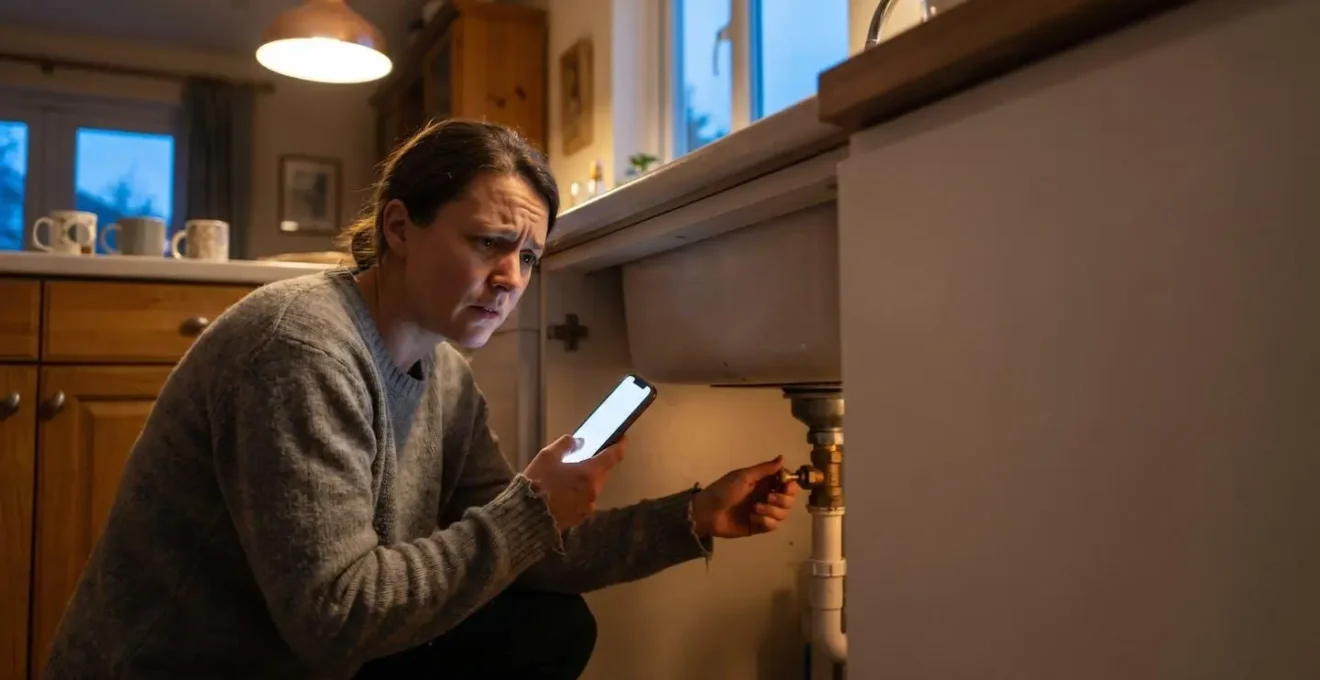
At 2 AM with water leaking, your first actions determine your insurance outcome, not the fine print you can’t find.
- Your most critical job is to stop the water flow by locating and turning off the main stopcock immediately.
- Document the damage with photos and videos *before* any repair work begins to create claim-proof evidence.
- Always call your insurer’s 24/7 helpline for authorization *before* agreeing to costs with a private plumber.
Recommendation: Treat the situation as an incident you are managing. Your goal is to mitigate damage and document every step to build an undeniable case for your insurer.
It’s 2 AM. The sound isn’t a dream. It’s a steady drip, a dark patch on the ceiling, or worse, a torrent of water where it shouldn’t be. In this moment of pure panic, the first instinct is to grab your phone. But who do you call? An emergency plumber who can be there in 30 minutes? Or your insurer, navigating a phone menu while your home soaks? The common advice to « check your policy documents » is useless right now. Your house is flooding, and you need a plan, not a library card.
This is where the dynamic shifts. You are no longer a victim of a burst pipe; you are the on-site incident commander. Your mission is not simply to stop the leak but to manage the crisis in a way that ensures your insurance claim is successful. This guide is your protocol, your dispatcher on the line, walking you through the critical decisions you need to make in the first hour. We will move beyond the generic advice and give you a clear sequence of operations: from the immediate mechanical fix to the crucial verbal contracts you’ll make over the phone.
We’ll cover the trade-offs between speed and cost, what ‘making safe’ truly means, and how to create the documentation that a loss adjuster can’t argue with. Forget fumbling for paperwork in the dark. This is your command-and-control guide to navigating an escape of water emergency.
This article provides a step-by-step protocol for managing a home water emergency to align with insurance requirements. The following table of contents outlines the key stages of your response, from the initial call to long-term prevention.
Summary: Emergency Plumbers and Insurance Cover
- Home Emergency Add-On: Is It Faster Than Calling Your Own Plumber?
- Stopcock Location: The 5-Minute Search That Can Save You £10,000 in Damage?
- ‘Make Safe’ Repairs: What Can You Fix Without Waiting for the Loss Adjuster?
- Plumber’s Invoice Details: What Must Be Written on the Bill to Ensure Reimbursement?
- Blocked Drains vs Collapsed Drains: Which One Will Insurance Pay For?
- Smart Water Valves: Can Spending £200 Save You a £5,000 Soak?
- The Duty to Mitigate: How Much Should You Spend on Emergency Repairs?
- Escape of Water: The #1 UK Insurance Claim and How to Prevent It?
Home Emergency Add-On: Is It Faster Than Calling Your Own Plumber?
This is the first command decision. Using your insurer’s Home Emergency add-on means the cost is covered, but you trade control for convenience. The plumber is approved, and you won’t see a bill for the call-out. The critical question is speed. Some home emergency service providers state that 75% of emergencies are attended within 4 hours. While impressive, four hours with an active leak is a lifetime of damage. Calling a local 24/7 plumber yourself might get someone on-site in under an hour, but you are now responsible for the cost upfront.
The decision is a financial triage. If the water is contained to a slow drip, waiting for the insurer’s approved contractor is a low-risk, financially sound choice. If water is pouring through a ceiling and causing significant structural or electrical risk, the immediate cost of a private plumber is likely far less than the cost of an extra hour of unchecked water damage. This is your first test as incident commander: assess the severity and choose the response that mitigates the most damage, not the one that is immediately cheapest.
Many policies allow you to use your own tradesperson for an emergency ‘make safe’ repair, provided you’ve informed your insurer. The key is to make that call to their 24/7 helpline *before* work begins. This call establishes a record and often gets you a verbal agreement for reimbursement of reasonable costs.
Stopcock Location: The 5-Minute Search That Can Save You £10,000 in Damage?
Before you make any calls, your absolute first priority is to stop the flow of water. This is the single most impactful action you can take during what we’ll call the « golden hour » of the incident. Every second that water flows increases the final repair bill exponentially. With UK insurers paying out around £1.8 million every day for escape of water damage, your five-minute search for the stopcock is the highest-value task you can perform. The stopcock, or stop-valve, controls the entire water supply to your property.
Do not assume you know where it is. Check now. Common locations include:
- Under the kitchen sink
- In a downstairs bathroom or WC
- In a utility cupboard or under the stairs
- In the garage, near where the water pipe enters the house
It will typically be a small, brass valve with a tap-like handle or a simple lever. Turn it clockwise until it is tight to shut off the water. If it is stiff, use a cloth for grip but avoid using heavy tools that could break it. Knowing this location turns a major catastrophe into a manageable problem.
Once the water is off, you can take a breath. You have just taken command of the situation and significantly reduced the potential damage. Now, with the immediate threat contained, you have the clarity to move on to the next step: documenting the scene for your insurer before anyone starts a repair.
‘Make Safe’ Repairs: What Can You Fix Without Waiting for the Loss Adjuster?
With the water off, the immediate panic subsides, but a new question arises: what can you touch? Your policy contains a « duty to mitigate, » which means you’re expected to take reasonable steps to prevent the damage from getting worse. This doesn’t mean you should start major plumbing work. It means performing temporary, ‘make safe’ actions. This could involve placing buckets, moving furniture out of harm’s way, and drying up pooled water.
Before you or a plumber touches anything related to the source of the leak, your second critical mission begins: creating claim-proof evidence. A loss adjuster might not visit for days, so your initial photos and videos are the only record of the event’s severity. As a leading insurer points out, this is a core part of your responsibility.
Your insurance policy may require you to mitigate the damage as much as possible, even if it means making temporary repairs to prevent further destruction.
– GEICO Insurance, Homeowners Insurance Plumbing Coverage Guide
The protocol is simple but non-negotiable. Using your smartphone, you must document everything. Take wide shots of the affected rooms to show the scale of the damage. Then, take close-up photos and videos of the source of the leak (the burst pipe, the failed connection) from multiple angles. If water was actively flowing, a video with sound is powerful evidence. This documentation is your primary tool in securing a fair settlement.
Action plan: your pre-repair documentation protocol
- Photograph the source: Take clear, well-lit photos and videos of the exact point of failure (e.g., the burst pipe, the broken valve) before any tools touch it.
- Document the damage: Capture images of all affected areas—wet carpets, damaged ceilings, soaked furniture. Use a ruler in some shots to show water depth.
- Record with sound: If the leak is still active (even a drip), a short video that captures the sound provides undeniable proof of the emergency’s nature.
- Timestamp your evidence: Ensure the timestamp feature on your phone’s camera is active or send the photos to yourself in an email to create a digital timeline.
- Preserve damaged items: Do not throw away the faulty part (e.g., the broken flexi-hose). Keep it as physical evidence for the loss adjuster to inspect.
Plumber’s Invoice Details: What Must Be Written on the Bill to Ensure Reimbursement?
If you’ve called a private plumber for a ‘make safe’ repair, the invoice they provide is not just a bill; it’s a key piece of evidence for your claim. A vague or poorly detailed invoice is one of the fastest ways to have a portion of your claim rejected. As the incident commander, you must brief the plumber on exactly what information you need documented. You are not just paying for a repair; you are commissioning a report.
The invoice must clearly separate the components of the job. The emergency call-out fee needs to be its own line item. Labour must be itemised, showing the hourly rate and the exact number of hours worked. All materials used, even small fittings, must be listed with their individual costs. Crucially, the description of the work performed should be specific and use language that aligns with insurance terms.
Phrases like « Emergency make-safe repair to mitigate active escape of water from burst pipe under sink » are far more powerful than « Fixed leak. » One is a professional report; the other is a note. Ensure the date and, critically, the time of the call and the time of completion are on the document. This validates the emergency nature of the work. Finally, paying by card creates a clear, timestamped financial record that complements the paper invoice.
Your audit checklist: creating a claim-proof plumber’s invoice
- Isolate the Call-Out Fee: Instruct the plumber to list the « Emergency Call-Out Fee » as a distinct line item, separate from labour or materials.
- Itemise Labour and Materials: Verify the invoice lists the exact hourly rate, the total hours worked, and a detailed breakdown of every single part used with its cost.
- Confirm the Service Description: Check that the description of work explicitly states it was an « emergency make-safe » repair to « mitigate an active escape of water. »
- Verify Date and Time Stamps: Ensure the invoice includes the exact date and time you made the call and the time the plumber completed the work. This proves the urgency.
- Create a Digital Payment Record: Pay the invoice using a credit or debit card. This generates an independent, timestamped financial record of the transaction for your claim file.
Blocked Drains vs Collapsed Drains: Which One Will Insurance Pay For?
Understanding the semantics of your insurance policy is crucial, especially when it comes to drainage. Insurers draw a hard line between damage caused by gradual wear and tear or lack of maintenance, and damage that is sudden and accidental. This distinction is most apparent with drains. A blocked drain, caused by a buildup of fat, wet wipes, or other items you’ve put down it, is almost always considered a maintenance issue and is not covered by standard home insurance.
A collapsed drain, however, is a different story. If the drain collapses due to an external, accidental event like ground heave, vehicle impact, or even sudden damage from tree roots (though this can be a grey area), it is often covered. The damage is accidental, not a result of poor upkeep. The key is proving the cause.
This is where « trace and access » cover becomes vital. This is often an add-on to your policy that covers the cost of finding the source of a leak, which can be substantial. It pays for the work needed to expose the pipe, such as digging up a floor or breaking through a wall. Some policies have generous limits for this; for example, Aviva Signature Home Insurance can cover up to £5,000 for tracing and accessing a leak. Without this cover, you could be liable for thousands in investigative work, even if the subsequent repair is covered.
Similarly, damage from sewer backups is typically excluded from standard policies, but specific endorsements can be purchased to cover this risk. The rule of thumb is simple: if the problem is a result of something you (or your family) did over time, you’ll likely have to pay. If it’s a sudden, unforeseen accident, your insurance is more likely to respond.
Smart Water Valves: Can Spending £200 Save You a £5,000 Soak?
After the crisis is managed and the repairs are underway, the focus must shift to prevention. An escape of water event is a traumatic and disruptive experience, and ensuring it never happens again is a sound investment. With data suggesting that almost 43% of UK domestic properties have suffered from water leaks, proactive measures are not an overreaction; they are a necessity. While seasonal checks on pipes and hoses are essential, technology now offers a more robust solution: the smart water valve or leak detection device.
These devices are installed on your incoming water main, near the traditional stopcock. They work by monitoring the flow of water through your pipes. They learn your household’s typical water usage patterns. If the device detects a continuous flow that deviates from the norm—such as a slow, constant drip from a hidden leak or a sudden, large gush from a burst pipe—it will automatically shut off the water supply and send an alert to your smartphone.
The cost of these devices, typically starting around £200-£400 plus installation, can seem high. But when weighed against the average cost of a major water damage claim, it is a small price for immense peace of mind. As the Association of British Insurers (ABI) notes, insurers are actively encouraging their adoption.
Consider fitting a leak detection device which will monitor your usual water use and turn off the water if it suspects a leak. Some insurers may offer help with the installation of a leak detection device and may also take this into account when pricing your cover.
– Association of British Insurers, Burst Pipes and Water Leaks Prevention Guide
Installing a smart water valve is the ultimate « make safe » action. It stands guard 24/7, acting as a permanent, vigilant dispatcher for your home’s plumbing system. It’s an investment not just in property protection, but in preventing the stress and disruption that a water leak inevitably causes.
The Duty to Mitigate: How Much Should You Spend on Emergency Repairs?
You have a duty to mitigate your loss, but this does not give you a blank cheque. The critical question, as you stand with a plumber on-site, is how much is « reasonable » to spend on an emergency repair. Your insurer will only reimburse costs they deem fair and necessary to prevent further immediate damage. They will not pay for a full, permanent repair to be conducted at emergency, out-of-hours rates.
This is the moment of financial triage. The goal is to stop the leak and secure the property, nothing more. If a plumber quotes £1,500 to not only stop a leak but also replace an entire section of pipework, your insurer will likely only reimburse the portion related to the immediate ‘make safe’ action, perhaps £200-£400. The rest is considered a permanent repair that should be quoted and approved in the calm of the next business day.
To avoid a dispute, you must get verbal authorisation from your insurer for any proposed spend. This is a non-negotiable step if you have called your own plumber. Follow this script when you call your insurer’s 24/7 helpline:
- State the situation clearly: « I am calling to report an active escape of water at my property. I have a plumber on-site to conduct an emergency make-safe repair. »
- Present the cost: « The plumber has quoted £X for a temporary fix to stop the leak and prevent further damage. This is not for a full repair. »
- Request explicit authority: « Do I have your authority to proceed with this emergency repair cost of £X? »
- Document the call: Note the exact time of the call, the name of the agent you spoke to, and their response. State, « For the record, my name is [Your Name], and you are [Agent’s Name], and you have authorised a spend of up to £X for a temporary repair at [Time] on [Date]. »
This verbal contract, documented by you, is powerful evidence. It confirms you acted responsibly and in coordination with your insurer, making the reimbursement process much smoother.
Key Takeaways
- Your first action is always mechanical, not administrative: locate and turn off the main stopcock.
- Document everything with timestamped photos and videos *before* any repairs begin. This is your most crucial evidence.
- If using your own plumber, get verbal authorisation and a cost limit from your insurer’s 24/7 line before work starts.
Escape of Water: The #1 UK Insurance Claim and How to Prevent It?
Escape of water is the most common type of home insurance claim in the UK, more frequent than fire or burglary. It represents a huge cost to insurers and massive disruption for homeowners. While a catastrophic burst pipe is what often comes to mind, most of these claims originate from small, persistent leaks from failed appliance hoses, worn seals, and corroded pipework. The damage is often hidden, accumulating over weeks or months before it becomes visible.
Prevention is a year-round activity, a series of small checks that can avert a disaster. It involves being aware of the typical lifespan of common plumbing components and inspecting them proactively, rather than waiting for them to fail. A simple seasonal schedule of checks can make a significant difference. In autumn, focus on insulating any external pipes to prevent freezing. In spring, inspect the flexible hoses on your washing machine and dishwasher for cracks or bulges. These are among the most common failure points.
The table below highlights some of the hidden risks in your home. The replacement cost is trivial compared to the potential damage cost if they fail. This data underscores the value of preventative maintenance over reactive emergency repairs.
| Failure Point | Typical Lifespan | Replacement Cost | Potential Damage Cost |
|---|---|---|---|
| Braided toilet/sink hoses | 5-8 years | £10-25 | £2,000-5,000 |
| Washing machine inlet pipes | 3-5 years | £15-30 | £3,000-8,000 |
| Refrigerator ice-maker lines | 5-7 years | £20-40 | £1,500-4,000 |
| Water heater pressure valve | 10-15 years | £50-100 | £5,000-15,000 |
Ultimately, taking command of a water leak emergency is only the first half of the job. The second, more important half is implementing a strategy to ensure you never have to do it again. A combination of regular visual inspections, understanding the lifecycle of your plumbing components, and potentially investing in leak detection technology is the most effective long-term insurance policy you can have.
Your next logical step is to create your own home prevention schedule. Use the seasonal tips in this guide to build a recurring calendar reminder to inspect hoses, test your stopcock, and check for minor leaks before they become major disasters.