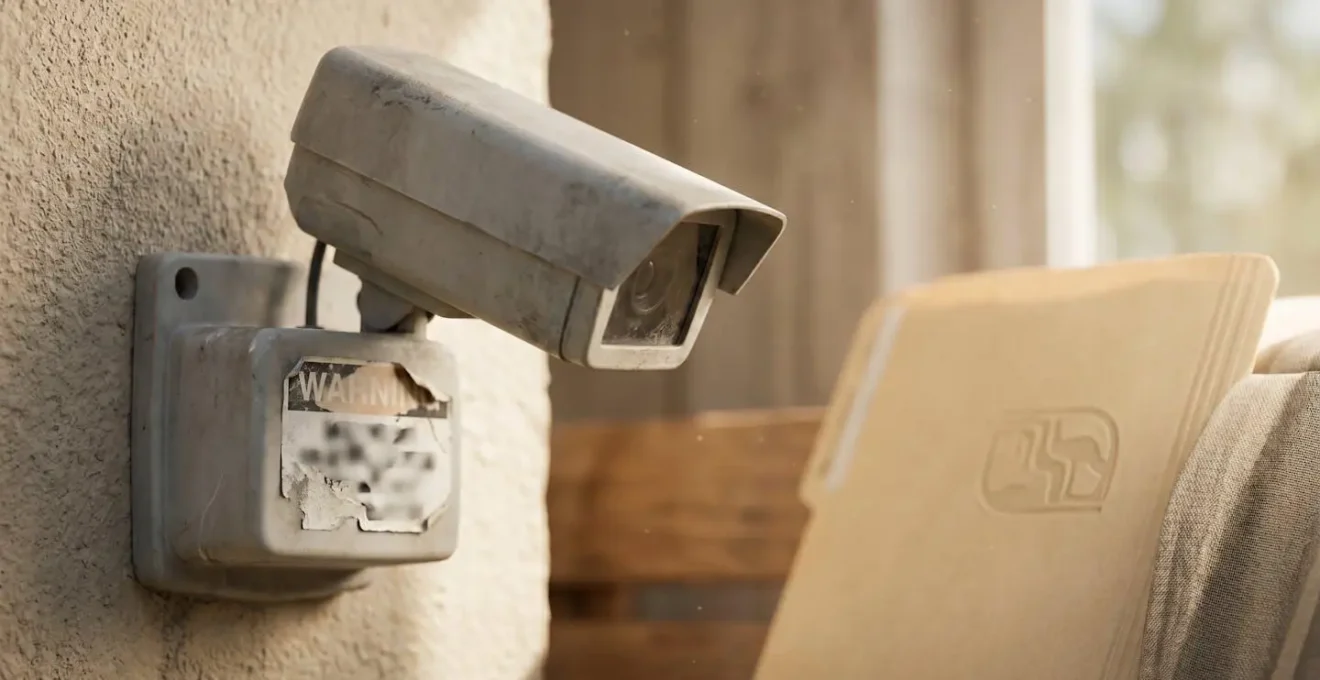
Contrary to the ‘better than nothing’ belief, relying on fake cameras can actively jeopardise your home insurance claim by demonstrating a failure to take ‘reasonable care’.
- Insurers view dummy devices not as a deterrent, but as evidence of negligence, a key reason for claim denial.
- Experienced burglars can often spot fakes, turning your home into a perceived low-risk target.
Recommendation: Focus on insurance-compliant physical security, like BS3621 locks, which provides genuine protection and satisfies the core terms of your policy.
As a homeowner, you’re faced with a constant balancing act: securing your property against threats while managing a budget. The appeal of a dummy security camera is undeniable. For a fraction of the cost of a real system, it seems to offer a powerful visual deterrent. It’s a simple, tempting solution that many believe is ‘better than nothing’. But what if this common-sense ‘hack’ is not only ineffective but could actively lead to your insurance claim being rejected in your moment of greatest need?
The core of the issue lies in a concept that is central to every insurance policy: reasonable care. Insurers don’t just protect you from bad luck; they enter into a contract assuming you will take sensible, standard precautions to protect your own property. From their perspective, installing a fake camera is not taking reasonable care. It’s engaging in ‘security theatre’—creating an illusion of safety without the substance. This fundamental misunderstanding of risk is what can turn a cost-saving measure into a costly mistake.
This article will move beyond the simple debate of whether fake cameras ‘work’. As a crime prevention officer, my goal is to walk you through a burglar’s mindset and an insurer’s contractual logic. We will explore the subtle but critical forms of negligence that can void a policy—from leaving keys visible to posting holiday snaps on social media. Crucially, we will identify the concrete, approved security standards, like BS3621 locks, that satisfy insurers and provide genuine protection.
This guide provides a clear roadmap to understanding the real-world implications of your security choices. By examining specific vulnerabilities and their approved solutions, you will learn how to build a layered defence that not only deters criminals but also stands up to the scrutiny of an insurance assessor. The following sections break down these key areas.
Contents: Understanding Your True Security Obligations
- The ‘Shop Window’ Effect: Why leaving Keys Visible from the Letterbox Is Negligence?
- The ‘Check-In’ Risk: Why Posting Holiday Photos Can Invalidate Theft Claims?
- Side Gates and Trellis: The Weak Point 70% of Burglars Exploit
- SmartWater and UV Pens: Does Forensic Marking Actually Deter Thieves?
- Smart Plugs vs Mechanical Timers: Which Simulation Is More Convincing?
- Why Do Insurers Reject Claims if Your Locks Are Not BS3621 Compliant?
- Anti-Snap Cylinders: Why Standard Euro Locks Leave You Vulnerable in 15 Seconds?
- BS3621 Standards: How to Identify if Your Mortice Lock Is Insurance Approved?
The ‘Shop Window’ Effect: Why leaving Keys Visible from the Letterbox Is Negligence?
The term ‘breaking and entering’ can be misleading. Often, a burglar’s entry is far less destructive and far more opportunistic. The front door remains the most common point of entry in burglaries, and a significant number of these intrusions involve a technique known as ‘letterbox fishing’. This is where a thief uses a rod or wire to hook keys left on a nearby table or on hooks visible through the opening. It is the physical equivalent of leaving your bank password on a sticky note next to your computer.
From an insurance perspective, this scenario is a clear-cut case of contributory negligence. You have inadvertently provided the means for the theft. Leaving keys within sight or reach of the letterbox is considered a failure to take ‘reasonable care’ to secure your property. It creates an open invitation, a ‘shop window’ display for an opportunistic criminal. No amount of security elsewhere can compensate for such a basic lapse in protocol.
An insurer will argue that by leaving the keys accessible, you have failed to uphold your end of the policy agreement. They expect you to secure all points of entry and manage the tools—the keys—that operate them. If a claim arises from a situation where you made the burglar’s job easier, the likelihood of that claim being partially or fully denied increases dramatically. The solution is simple and costs nothing: store all keys, especially car keys, in a location that is both out of sight and out of reach from any external access point, including windows and cat flaps.
The ‘Check-In’ Risk: Why Posting Holiday Photos Can Invalidate Theft Claims?
In the digital age, your home’s security perimeter extends far beyond your physical property line; it includes your digital footprint. Sharing your life on social media has become second nature, but broadcasting your holiday from a sunny beach in real-time is the modern equivalent of leaving a note on your front door that reads, « Nobody is home for two weeks. » It’s a public announcement of your property’s vulnerability, and both criminals and insurers are paying attention.
This isn’t a theoretical risk. A study highlighted that an alarming 40% of social media users who were burgled suspected their posts had tipped off the thieves. The connection is direct and causal. If you publicly post that you are away, and your home is subsequently burgled, an insurer can argue that you have again failed to take ‘reasonable care’. You have knowingly advertised an empty property, increasing its risk profile exponentially and potentially invalidating your theft claim.
Case Study: The Price of a Post
In a well-documented case, a family from Nottingham returned from their holiday to find their home had been completely ransacked. The police investigation quickly uncovered the likely cause: a series of public Facebook posts, including photos and ‘check-ins’ from their overseas trip. The criminals didn’t need to stake out the house; the family’s social media feed served as a real-time calendar confirming the property was vacant and ripe for targeting.
The responsible approach is to exercise digital discipline. Share your wonderful holiday memories, but only after you have safely returned home. Ensure your privacy settings are robust, limiting your posts to a trusted circle. Resisting the urge to post in the moment is a crucial, modern-day security measure that demonstrates to an insurer that you are proactively managing all potential risks to your property.
Side Gates and Trellis: The Weak Point 70% of Burglars Exploit
While homeowners often focus their security efforts on the front door, experienced burglars frequently assess the path of least resistance, which often leads them to the side or rear of a property. An unlocked side gate, a low fence, or decorative trellis work are not just features of your garden; they are potential access tools for an intruder. That beautiful trellis becomes a ladder, and the flimsy bolt on the side gate is a minor inconvenience at best. Recent crime statistics show that a significant portion of entries are made through back doors, underscoring the importance of securing your property’s entire perimeter.
A weak side entrance is a major red flag for an insurance assessor. It signals that your security is one-dimensional and focused only on the most obvious entry point. Allowing unimpeded access to the more secluded parts of your property gives a burglar time and cover to work on a back door or window, free from the view of passers-by. Failing to secure these access points can be interpreted as a failure to maintain a secure perimeter, another form of negligence.
Strengthening this weak point is a matter of layered defence. It’s not about building a fortress, but about creating enough obstacles to make your property a less attractive target. This demonstrates ‘reasonable care’ in action. Consider these steps:
- Good: At a minimum, all side gates should be fitted with a robust, key-operated lock. The gate itself should be solid and at least as high as the surrounding fences.
- Better: Reinforce your defences by adding anti-climb toppings, such as a strip of trellis or angled wood, to the top of gates and fences. This makes scaling the perimeter more difficult and hazardous.
- Best: For the highest level of security, integrate the gate into your home’s alarm system with a contact sensor. This transforms the gate from a passive barrier into an active part of your defence, providing instant alerts if breached.
SmartWater and UV Pens: Does Forensic Marking Actually Deter Thieves?
The psychology of deterrence is complex. A fake camera relies on the hope that a burglar will be fooled at a distance. True deterrence, however, is not about creating an illusion but about increasing the real-world risk for the criminal. This is where forensic marking systems like SmartWater or simple UV pens come into play. They don’t stop someone from physically taking an item, but they drastically increase the thief’s risk of being caught and convicted later. This is a crucial element in the burglar’s calculus—the cost-benefit analysis they perform before a crime.
Unlike a dummy camera, which offers no consequence, a sticker in a window warning that all property is forensically marked sends a powerful message. It tells a potential thief that any stolen goods are traceable, difficult to sell on, and will directly link them to the crime scene if they are caught in possession. This shifts the risk-reward ratio heavily against the criminal. Research consistently shows that a property’s perceived security level is a major factor in a burglar’s decision-making. For instance, homes without any security measures are three times more likely to be targeted.
While forensic marking is not typically a mandatory requirement for standard insurance policies, using it is a powerful way to demonstrate that you are going above and beyond ‘reasonable care’. It shows you are thinking like a crime prevention expert, focused on not just deterring entry but also on aiding recovery and prosecution. In the event of a claim, being able to show the police and your insurer a register of your marked items is a clear sign of a responsible and security-conscious homeowner. It’s a proactive step that moves you from the category of ‘easy target’ to ‘hardened target’.
Smart Plugs vs Mechanical Timers: Which Simulation Is More Convincing?
A dark, silent house is a clear sign of an empty one. For decades, the standard advice has been to use timers to switch lights on and off, creating the illusion of occupancy. The classic, mechanical segment timer has been a staple of holiday security. However, in an era where burglars are more sophisticated, the very predictability of these devices can be their downfall. A single lamp clicking on at exactly 7:00 PM and off at exactly 11:00 PM every single day is a pattern that is easily recognised as artificial by an observant thief.
This is where modern technology offers a more convincing alternative. Smart plugs, controlled via a smartphone app, elevate the illusion of occupancy to a new level. Unlike their mechanical counterparts, they allow for randomised and varied schedules. You can have a living room lamp turn on for a couple of hours, then a bedroom light for 30 minutes, and even have a radio play at intermittent times. This creates a chaotic, unpredictable pattern that more closely mimics the natural behaviour of people living in a home.
From an insurer’s perspective, while either method is better than nothing, using smart plugs demonstrates a higher level of security consciousness. It shows you have thought critically about the quality of your deterrent. The mechanical timer meets the bare minimum, but the smart plug shows a more sophisticated understanding of the burglar’s calculus. You are not just creating ‘light’; you are creating a believable human presence. This nuanced approach to ‘reasonable care’ can be a small but significant factor in painting a picture of you as a diligent homeowner, should you ever need to make a claim.
Why Do Insurers Reject Claims if Your Locks Are Not BS3621 Compliant?
Your insurance policy is a contract with specific terms and conditions. Tucked away in the small print is often a clause that forms the bedrock of your physical security obligations: the requirement for approved locks. For many UK insurers, the gold standard is BS3621. This isn’t just a brand name; it’s a rigorous testing standard that certifies a lock is built to withstand common forms of attack, such as drilling, picking, and forcing, for a specified minimum period. When an insurer mandates BS3621, they are setting a minimum baseline of ‘reasonable care’ that you are contractually obligated to meet.
If you suffer a break-in and your locks are found not to meet this standard, your insurer has a contractual right to reject your claim. Their argument is simple: you did not uphold your end of the bargain. You failed to install the agreed-upon level of security, and this failure directly contributed to the loss. It doesn’t matter if you thought your lock was « good enough »; if it doesn’t have the BS3621 Kitemark, it’s non-compliant. Nationwide data shows the tough stance insurers can take, with some reports indicating that as many as 42% of home insurance claims can be denied for various reasons, with policy non-compliance being a major factor.
This requirement is absolute. Having five levers is not enough; the lock must be certified. Having one compliant lock on the front door but a non-compliant one on the back door is not enough, as most policies require all final exit doors to be secured to this standard. This is not an area for compromise or corner-cutting. Using a non-compliant lock is like installing a fake camera: it provides an illusion of security while leaving you completely exposed from a contractual and financial standpoint.
Anti-Snap Cylinders: Why Standard Euro Locks Leave You Vulnerable in 15 Seconds?
Forced entry remains a brute-force but highly effective method for burglars. One of the most common and shockingly fast techniques is known as « lock snapping. » This method targets a critical vulnerability in standard Euro cylinder locks, the type found on millions of uPVC and composite doors. By applying force to the part of the cylinder that protrudes from the door, a thief can literally snap the lock in two, exposing the mechanism and allowing them to operate the door in as little as 15 seconds. The loud « snap » you might expect is often the only thing between a secure home and an open door.
This vulnerability is a stark example of how a seemingly secure door can have a fatal flaw. A standard Euro cylinder, even when part of a multi-point locking system, can be the single point of failure. If your policy requires a certain standard of lock and your basic cylinder is snapped to gain entry, you could find yourself in a difficult position with your insurer. They could argue that, while you had a multi-point lock, the cylinder itself was not of a sufficient standard to resist common attack methods, thus failing the ‘reasonable care’ test.
The solution is to upgrade to anti-snap cylinders. These are designed with a built-in weakness, a « sacrificial snap line. » If a burglar attempts to snap the lock, only the external end breaks off, leaving the core of the lock mechanism intact and the door still secure. It’s an engineered solution to a specific and prevalent threat. Upgrading to anti-snap locks, particularly those that also meet the TS007 3-star or SS312 Diamond standards, is one of the most cost-effective and impactful security upgrades you can make. It directly addresses a known weakness and demonstrates a proactive approach to protecting your property against modern burglary techniques.
Key Takeaways
- Insurance negligence is defined by a failure to take ‘reasonable care’, which includes everything from the locks you use to the photos you post online.
- Your home’s security perimeter is not just physical; your digital footprint and online activity are now a key factor in risk assessment.
- True insurance compliance hinges on specific, verifiable standards like BS3621 for locks, not on subjective feelings of security or visual deterrents.
BS3621 Standards: How to Identify if Your Mortice Lock Is Insurance Approved?
Understanding the importance of BS3621 is one thing; verifying that your own locks meet the standard is another. It’s a critical check that every homeowner should perform, as the presence of this certification can be the deciding factor in whether a theft claim is paid. You don’t need to be a locksmith to perform an initial assessment. The key indicators are physically stamped onto the lock itself.
The British Standard Kitemark is a symbol of quality and rigorous testing. Its presence on the faceplate of your lock is the most reliable sign that it is insurance-compliant. As experts in security standards confirm, the certification is paramount.
Many home insurance companies will require a BS3621 certified lock on your external downstairs doors as a minimum to offer home insurance and although having a certified lock may not bring your premiums down, not having a certified lock could prevent you from getting home insurance.
– APECS Security Standards, APECS Industry Analysis on BS3621 Certification
This expert opinion highlights the dual risk: not only could a claim be denied, but you may not even be eligible for cover in the first place. The following checklist will guide you through the process of identifying whether your locks are up to standard. It’s a simple, five-minute task that could save you thousands.
Your Action Plan: Verifying Your Mortice Lock’s Compliance
- Examine the Faceplate: Open your door and look at the metal strip on the edge where the lock bolt emerges. This is the faceplate.
- Look for the Kitemark: Search for the British Standard Kitemark symbol. It looks like a heart shape containing the letters ‘BSI’.
- Find the Standard Number: The number « BS3621 » should be stamped clearly on the faceplate, often near the Kitemark. It may be followed by a year, such as BS3621:2007.
- Count the Levers: The lock must also be a 5-lever mortice lock. If it’s a 3-lever lock, it cannot be BS3621 certified, even if it has a Kitemark for a different standard.
- Consult a Professional: If you cannot see any markings, do not assume the lock is non-compliant. It may be an older model or require removal for identification. In this case, it is essential to consult a professional locksmith for verification.
Frequently Asked Questions about BS3621 Lock Compliance
My lock has 5 levers, so it’s BS3621 compliant, right?
False. While BS3621 locks must have at least 5 levers, not all 5-lever locks are BS3621 certified. The lock must also display the BSI Kitemark and BS3621 number to be compliant.
I have one BS3621 lock on my front door, am I covered?
False. Most insurance policies require BS3621 locks on all final exit doors, which typically includes both front and back doors and any side doors used for entry/exit.
What if I’m a renter and my landlord has provided non-compliant locks?
Non-compliant locks can affect your contents insurance. You should formally request in writing that your landlord upgrade to BS3621 locks, as this is often required for valid insurance coverage.